• Skip to main content
  • Skip to secondary menu
  • Skip to primary sidebar
  • Home
  • About
  • Contact
  • Schools
  • Government/Politics
  • Food/Restaurant
  • Arts/Entertainment/Media
  • History
  • Health and Fitness
  • Sports
  • Kobe At Lower Merion
  • 21st Century On The Main Line

This Is Lower Merion And Narberth

Serving the Main Line Community

  • Ardmore
  • Bala Cynwyd
  • Belmont Hills
  • Bryn Mawr
  • Gladwyne
  • Haverford
  • Merion
  • Narberth
  • Penn Valley
  • Penn Wynne
  • Rosemont
  • Villanova
  • Wynnewood

1931 Society Honor Slaying In Wynnewood Was A Huge National Story
by Gerry

1931 Society Honor Slaying In Wynnewood Was A Huge National Story

By Bob McNulty, originally published in Philadelphia Stories.
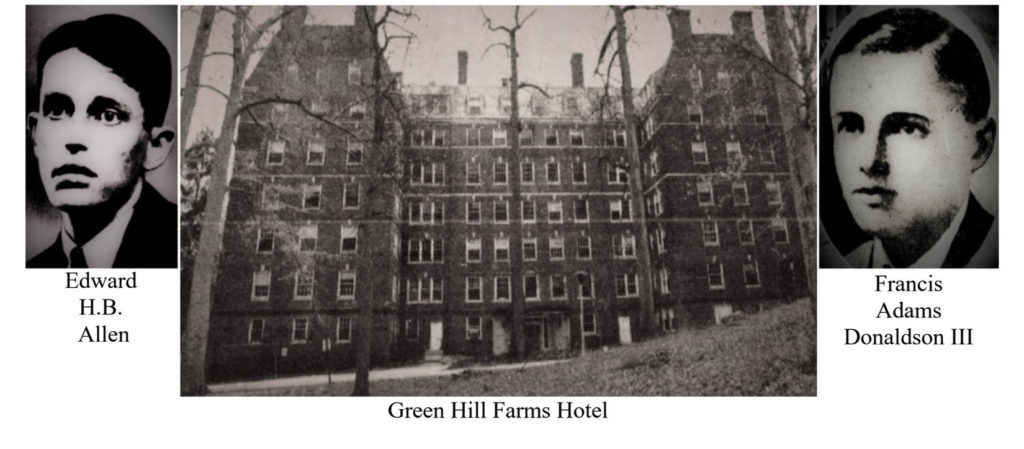
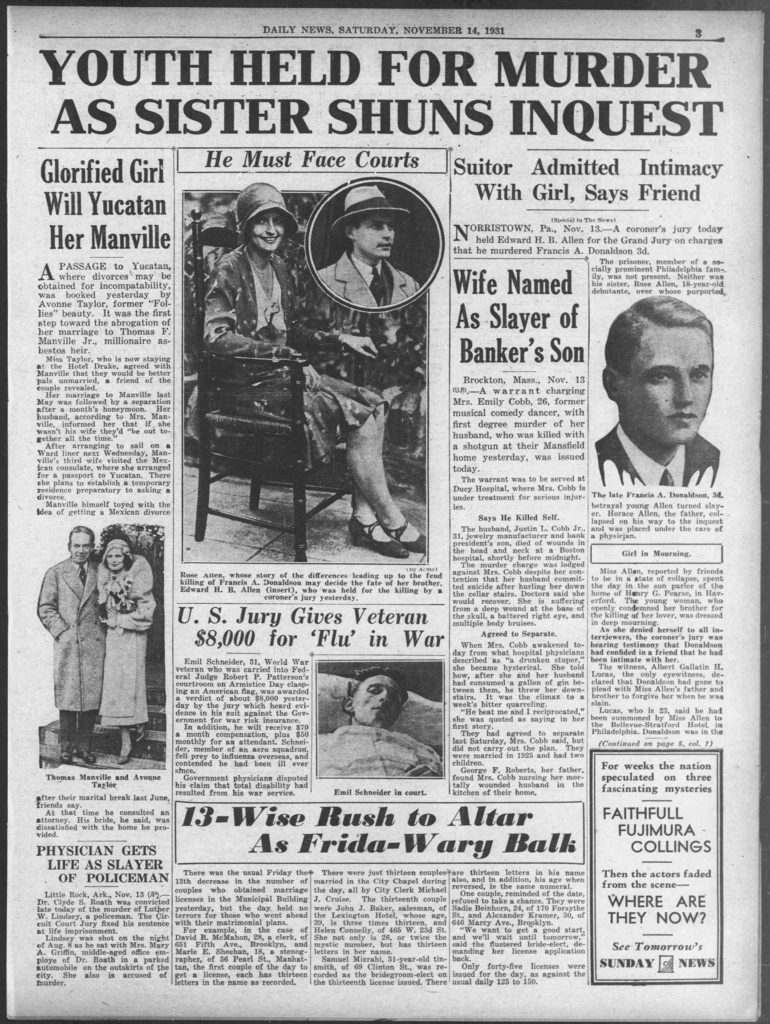
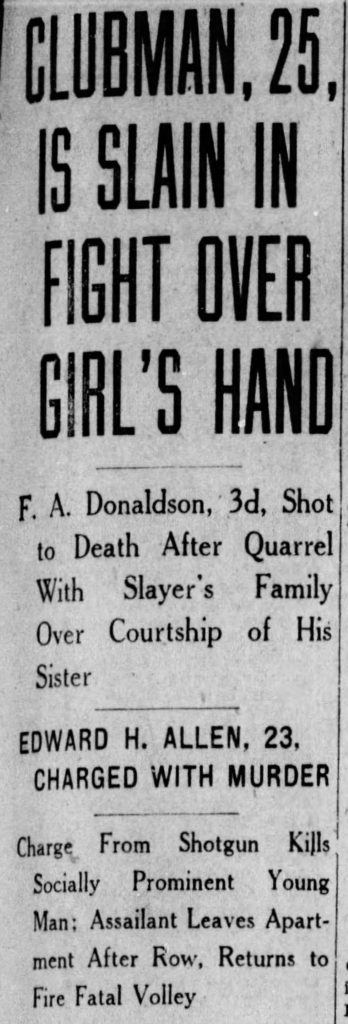
On November 9, 1931, Edward H. B. Allen, 23, mortally wounded Francis Adams Donaldson III, 24, with a shotgun in Apartment 2-C at the Green Hill Farms Hotel in Wynnewood (just outside the city limit, near the north-west corner of City and Lancaster Avenues). Both men came from socially prominent Philadelphia families. The subsequent murder trial in February 1932, captivated the entire country and spawned two Hollywood movies.


Allen Donaldson Honor Wynnewood Honor Slaying
 
The Allen family’s wealth came from the Sherwood Knitting Mills in Germantown, which was founded in 1844, by John Allen, an immigrant from Nottingham, England. In 1866, John retired and left the business in the very capable hands of his two sons, John Jr. and Benjamin. The mill was located at 4980 Sheldon Street (now Wister Playground), and the brothers lived just around the corner in two mansions; John Jr. at 314 Wister Street and Benjamin next-door at 304 Wister Street (N/E corner of Wister and Baynton).
 
Benjamin married Sarah Topham in 1859, and their union produced ten children: Kate (1859-1938), Benjamin Jr. (1861-1922), Anna (1862-1870), twins William (1866-1908) and Lizzie (1866-1874), John (1869, died at birth), Baby Boy (1871, died at birth) , Baby Boy (1873, died at birth), Horace (1874-1933) and Baby Boy (1876, died at birth). After 39 years of marriage and motherhood, Sarah died in October 1898, and Benjamin joined her seven months later.
 
Their four surviving children (Kate, Benjamin Jr., William, and Horace) inherited a trust fund of $350,000 (equivalent to $10.3 million today). Annually, they all received an equal stipend and, upon the death of the last surviving sibling, the remaining balance of the trust was to be divided equally among their offspring. The trust fund was Benjamin Sr.’s way of providing for his oldest child, Kate, who was intellectually and developmentally disabled (he also left the mansion on Wister Street and a summer cottage in Spring Lake N.J. solely in her name). Horace was the only sibling to pro-create, so eventually all of the money would go to his branch of the family tree. Horace married Rose Whitaker of Boston on April 25, 1905. The newlyweds joined his siblings at 304 Wister Street.
Horace was an avid sportsman. On Decoration Day in 1893, at age 18, he won all of the prizes at the Asbury Park Bicycle Races (the Philadelphia Inquirer praised his “phenomenal speed” and suggested that he should race professionally). In 1895, he joined the Bellfield Club of Germantown, where he took up golf and bowling.
 
Horace was also a member of the Automobile Club of Philadelphia (1409 Walnut Street). On October 20, 1906, he and Rose competed in a 108-mile race that was sponsored by the club, the winner receiving the Brazier Cup (named for the club’s president, H. Bartol Brazier, owner of the Brazier Auto Works, 38th and Market). The course ran from Philadelphia to Doylestown to Quakertown to Pottstown and then back to Philly. Originally there were thirteen cars entered, but only seven participated due to bad weather and slippery roads. Horace drove his brand new 1907 Buick. Traveling with him, besides Rose, were his cousin, Fannie Allen Dickey, and her husband, Lawrence Dickey. Horace finished a distant fourth behind the winner, William C. Longstreth (father of longtime Philadelphia City-Councilman Thacher Longstreth), who drove a Maxwell (he owned a Maxwell dealership) while completing the course in 5 hours and 54 minutes (avg. speed @ 18 m.p.h.).
Horace and Rose had three children: Edward H. B. Allen (May 23, 1908), William W. Allen (October 2, 1911), and Rose Elizabeth “Posey” Allen (October 23, 1913). 
 
The 1920 Census shows them still living in the family mansion on Wister Street along with seven employees: Anna Rigoulot (a French governess), Mary Fitzgerald (chambermaid), Mary Daley (waitress), Bridget Davis (cook), Bridget Birmingham (cook), Mary Birmingham (nurse), and Margaret Birmingham (parlor maid). Also living there was Horace’s brother Benjamin (who would die in 1922). As for Horace’s other two siblings, William died of pneumonia in 1908, and in 1913, Kate, was placed in the Gladwyne Colony Insane Sanitarium, where she would spend the last 25 years of her life (this would have displeased their father, who had always hoped that Kate would be cared for at home by family). Kate’s placement in the sanitarium coincided with the birth of Rose and the arrival of Horace’s in-laws from Boston, who lived with them on Wister Street for several years prior to the First World War.
 
In 1932, journalist Madelin Leof Blitzstein described Horace’s children this way: “Wister Street is a queer street. On one side are enormous mansions, where the wealthy make their homes, and across the way are the homes of people in much more modest circumstances (many of whom were employed in the mill by the Allen family). Young Eddie Allen was known as the snob of the neighborhood. He used to dash in and out of his home without so much as a glance at his more humble neighbors across the way. William spent most of his time away from home since earliest childhood. He attended fashionable schools out of town. Only Rose, or “Posey,” as her friends call her, seemed to enjoy playing with the other children on the block. She even went so far as to go into their homes on occasion and be real friends with boys and girls who were not old enough to realize the social gap that separated them.”
 
All three of the children had a passion for horses and became quite adept at the equestrian arts. Edward’s first race (pony under 14.5 hands) was on May 16, 1923 (one week before his 15th birthday), at the Wynnewood Pony Show. He finished third behind Catherine Clothier (granddaughter of Isaac Clothier Sr.) and Emilie du Pont (grandson of E. I. du Pont). Later that month, Edward was named by the Philadelphia Inquirer as one of the top exhibitors at the Devon Horse Show. On September 28, 1923, he raced at the Bryn Mawr Horse Show, and again finished third to Catherine Clothier. Emelia Bromley (granddaughter of Joseph H. Bromley) finished second.
William’s first race was on May 10, 1924 (he was 12), at the Indoor Horse Show, which was held at the 103rd Armory (32nd and Lancaster). He finished third in the pony under 14.5 hands category. Rose’s first race was six days later (she was 10) at the Wynnewood Pony Show (pony under 12.5 hands). She won and was awarded the Children’s Challenge Cup! Edward also raced that day, (pony under 14.5 hands) finishing second to another Clothier girl (Anita). Edward finally came into his own at the Indoor Horse Show (103rd Armory) on May 9, 1925, when he finished first in both the Hunter’s and Jumper’s Olympics. Soon, he would be named Master of Hounds at the Radnor Fox Hunt (one of the youngest ever to hold that post) and would become regarded as one of the finest gentleman riders on the East coast.
 
In 1925, Horace moved the family from their long-time home in Germantown to the Green Hill Farms Hotel (City and Lancaster Avenues), while a mansion he was having built, “Shadow Wood” on Tunbridge Road near College Avenue in Haverford, was being completed. They moved to Shadow Wood the following year. Mrs. Allen was fond of social pleasures, and hosted many teas and parties. 


Rose Allen Debutante


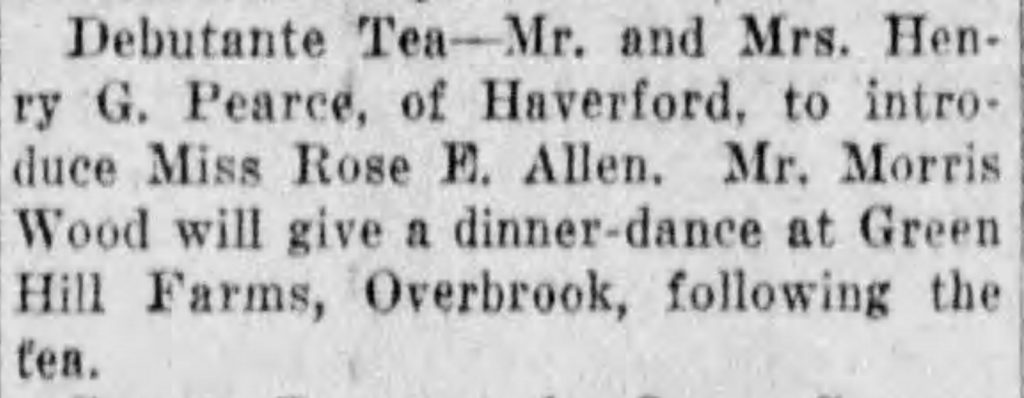
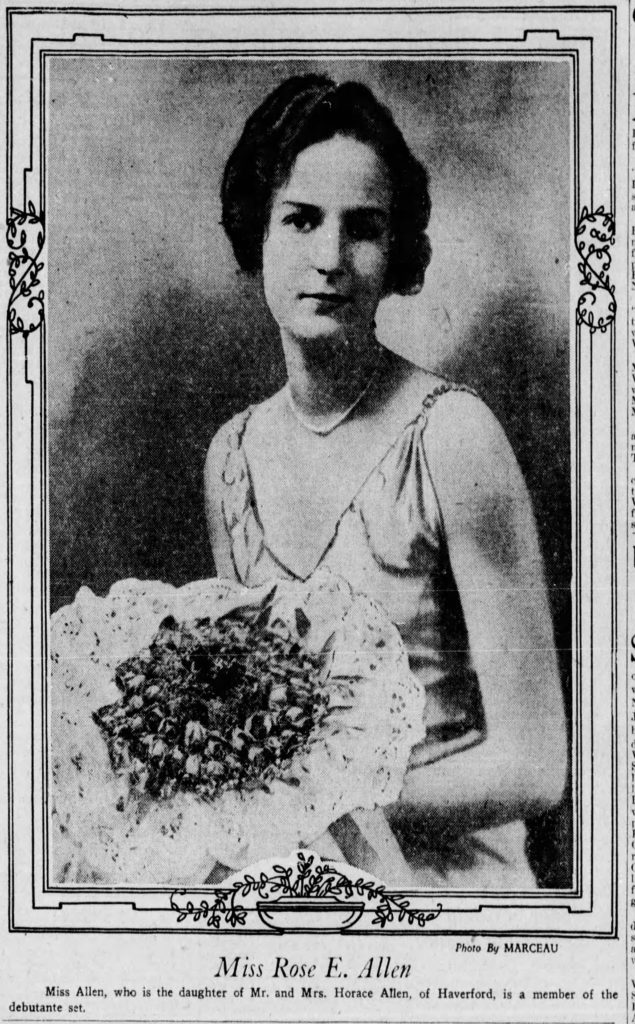
It was announced in the Inquirer on February 20, 1930 that Rose Allen would be introduced as a debutante at a tea given by her parents on October 28, 1930 (five days after her 17th birthday).However, due to the Great Depression, Horace was forced to close the mill in April 1930. He had used a great deal of his own money to try to keep it open, but his efforts failed. By August 1930, he was cash poor (and would be until he received his next trust fund stipend in 1931) and could not afford to give his daughter the promised tea in October. When his good friends, Henry and Leita Pearce (Henry was a wealthy banker), heard about Horace’s plight, they took over the tea party arrangements. Also stepping up were James and Elizabeth Potter of 2213 St. James Place, who gave a dinner in Rose’s honor on September 15, 1930. James was formerly a part-owner and president of the Phillies (1901-1909) and, at the time of Rose’s dinner, was the General Manager of the Cunard Steamship Line. Henry and Leita hosted the tea as planned on October 28th, and then later that evening, another friend, Morris Wood, the owner of the Green Hill Farms Hotel, gave a dinner dance for Rose. At the dance, Rose met Francis Adams Donaldson III.
 
Francis Adams Donaldson III’s great-grandfather was John P. Donaldson of 20 Catharine Street (Catharine and Swanson), a spar manufacturer, who owned yards in Southwark and Kensington. John had three sons and, when he died in 1845, he left each of them a third of his estate, payable upon reaching the age of 21. John’s youngest son, Francis Adams Donaldson (Sr.), received his share, about $800 (equivalent to $21,000 today), in 1861, but before he could decide what to do with it, the Civil War broke out and he joined the Union Army. He enlisted as a Sergeant but was quickly promoted to the rank of Captain, Company H, 118th (Corn Exchange) Pa. Infantry Regiment.
 
After being mustered out of the army in 1864, Francis moved in with his older brother Jacob (a hardware merchant) at 1916 W. Rittenhouse Square. Francis invested his money in marine and fire insurance and opened an office at 3rd and Chestnut Streets. In 1870, he married Mary Landell, and they had three children: Francis Adams Donaldson Jr. (1875), Kate (1876), and Wharton (1880). They lived at 1831 Filbert Street (now JFK Boulevard) and later at 4307 Spruce Street.
 
Francis Adams Donaldson Jr. attended the University of Minnesota and upon his graduation in 1896, he joined his father’s business. He was made a partner in 1899. In 1904, Francis Jr. married Martha “Mattie” Oelbermann. They moved to 450 S. 43rd Street and had two children: Francis Adams Donaldson III (August 14, 1907) and William (October 4, 1908).
Francis III, who attended the Haverford School, took an early interest in boxing and by the time he was 12, had become a skilled pugilist. When he fought fellow student Daniel Guggenheim II (son of M. Robert Guggenheim and stepson of Morton Snellenburg) in 1920, their classmates had $7,000 (equal to $85,000 today) wagered on the bout (in which Francis III was victorious).
 
Francis III had an adventurous nature and when he turned 21, he decided to take an eight month trip around the world, stopping in 28 countries. While in Paris, he was arrested and fined 175 francs for disturbing the peace during a late night search for free lodgings. A few weeks later, he was arrested on the Island of Rhodes for swimming ashore to avoid paying a nominal lighterage fee. Then just days later, he was arrested in Piraeus, Greece for swimming ashore after his ship was banned for health concerns. After visiting the pyramids in Egypt, he crossed into Palestine, where he traveled through the Holy Land on foot. Francis started the trip with $1025 (equal today to $15,000) but his funds were not sufficient to circumnavigate the globe. He became stranded in China and had to wire his father for passage home. On April 17, 1929, he arrived in San Francisco from Yokohama, Japan and from there, he slowly made his way to Pennsylvania. Francis returned home (435 Sabine Avenue, Wynnewood) during the third week of May 1929.


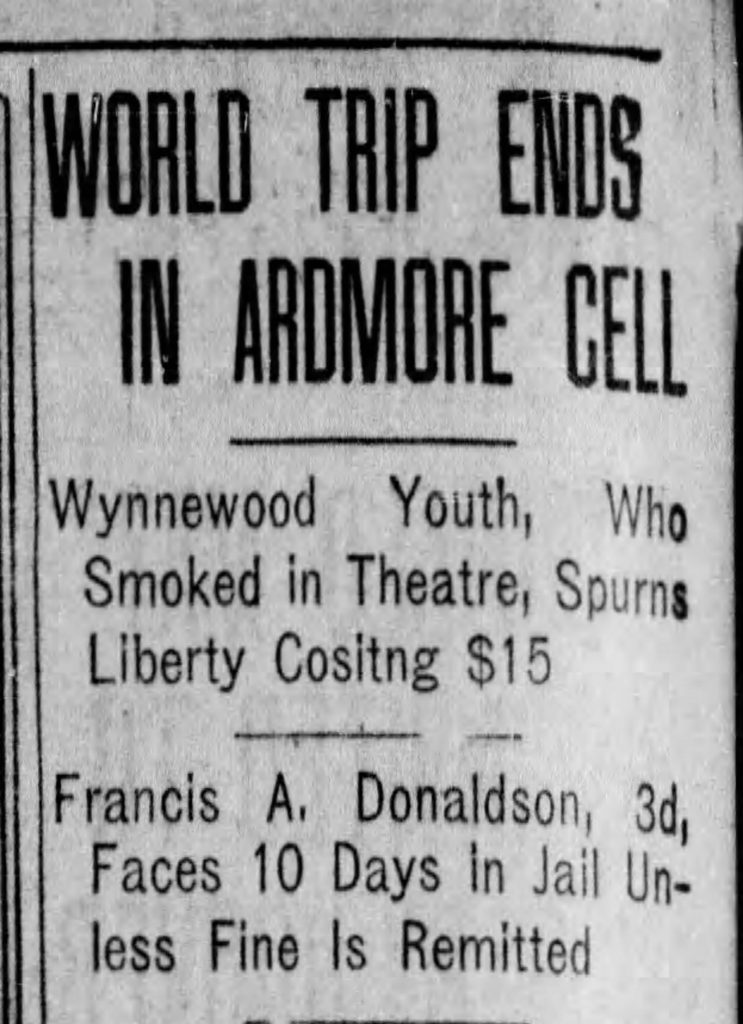
On June 10, 1929, Francis III decided to see a movie at the Ardmore Theater (34 W. Lancaster Avenue, Ardmore). As the Movietone newsreel flickered on, he lit up a big cigar. The manager came over and told him that smoking was prohibited, but Francis refused to extinguish his stogie. He was arrested and was brought before Magistrate Horace Stillwagon at the Lower Merion Police Station. “But your Honor,” he protested, “I’ve smoked in places all over the world.” “Well, you can’t do it in the Ardmore Theater,” responded the unimpressed magistrate, who then gave him a choice of a $15 fine or 10 days in the county jail.
 
Francis III did not have enough on him to cover the fine, so he phoned his father for help. Francis Jr. was still a bit sour over his son’s recent behavior abroad and replied, “You can spend the ten days in jail and then go spend the rest of your days in hell.” His younger brother, William, showed up a few hours later with $15 out of his own pocket, but Francis, not wanting to take his money, refused it, saying “I’ve been in worse places.” He was then transferred to the Montgomery County Prison where he remained for 10 days. Later that month, he appeared in a photograph on the Inquirer’s society page at the (Henry) Bowers Barn Dance, puffing on a pipe as carefree as the wind. 
 
 
The Announcement
On October 28, 1930, Francis III was one of the guests at Rose Allen’s debutante dance at the Green Hill Farms Hotel. He was 23 and she was 17. He was brash and cocky, but had a gift for glib conversation and possessed an endless number of breath-taking anecdotes. Rose found him irresistible and he became a frequent visitor at Shadow Wood. Rose’s parents disliked the boy immensely, finding him to be rude, disrespectful (he once greeted Mrs. Allen with a slap on the back) and a bad influence on their quiet and reserved daughter (who now fancied herself a flapper).

Rose’s mother took ill in March 1931. She was admitted to Jefferson Hospital where it was discovered that she had hepatic cirrhosis. She fought for two weeks, but died on April 9, 1931. Her last thoughts were of Rose. Just before expiring, she made Horace swear that he would not allow their Posey to marry Francis Donaldson. She was certain that he would be the ruin of her.
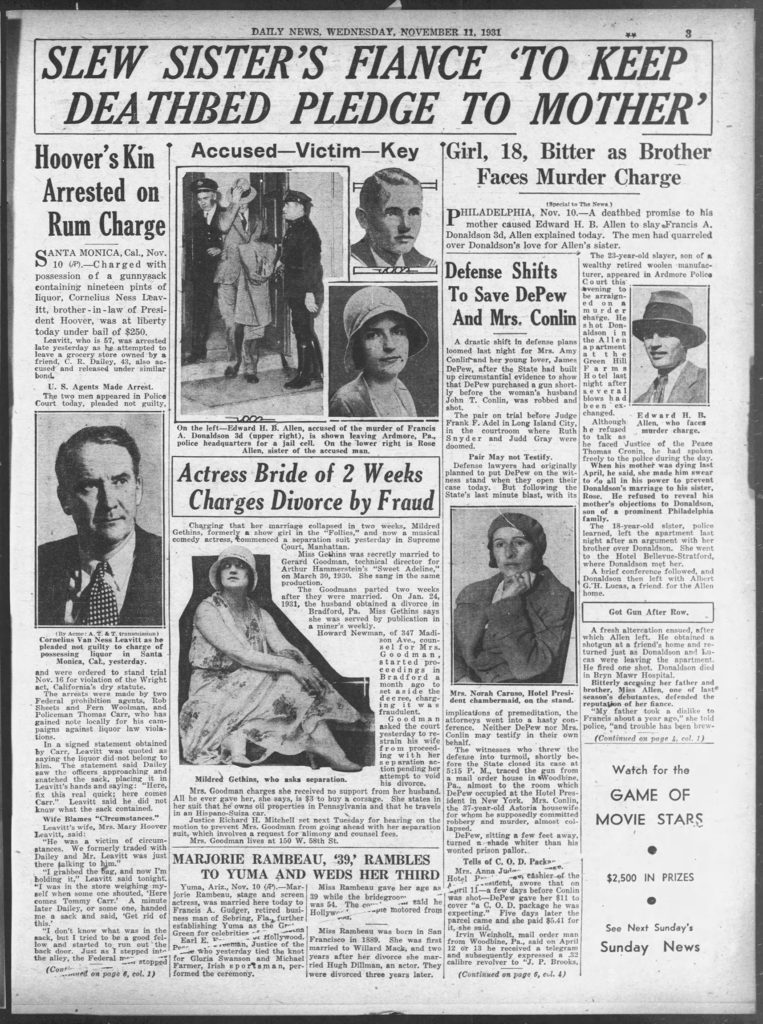
Not long after his wife’s death, the bank foreclosed, and Horace lost Shadow Wood. His old friend, Morris Wood, invited them to come back and live at the Green Hill Farms Hotel. They took him up on his offer and Horace, Edward and Rose moved into apartment 2-C. William had an offer to train horses in Warrenton, Virginia, so he headed south.
 
Against Horace’s objections, Rose continued to date Francis. By June 1931, they were seeing each other nearly every evening. During the second week of August 1931, Rose informed Horace that she was going to spend a few days with friends at Bay Head, New Jersey (Barnegat Bay) and Francis (who was celebrating his 24th birthday that week) would be accompanying her. From there, they would travel to Warrenton, Virginia, to visit William. They arrived in Warrenton three days late, explaining to her brother that they decided to stay a few days with a family named McGill in Island Heights, New Jersey. William phoned Horace and told him about their delay and that he doubted their explanation. Horace contacted Mr. McGill who confirmed William’s suspicions, Rose had told a lie.
 
Francis blew his stack when he found out that William told Horace about their tardy arrival. He knocked out William’s two front teeth and tried to strangle him with his necktie (until Rose managed to get between them).
 
When Rose returned home, Horace confronted her, and she admitted the whole thing; after leaving Bay Head, they spent three glorious days having sex in a motel in Scranton, but everything was copacetic, because they were in love. Horace was horrified. Not only did he have a promise to his late wife to keep, but he needed Rose to marry someone who could help them restore their lost wealth. While the Donaldson’s were well off, they did not possess the kind of money necessary to get the mill going again.
 
A few days later, Horace and Edward met with Francis and his father. Francis admitted to the Scranton incident and, like Rose, declared that they were in love. Horace made it quite clear that he despised the boy (as did his late wife), and was not in favor of a wedding. Mr. Donaldson was also not in favor of a wedding, saying that his son was not mature enough for such responsibility. Fearing that a forced breakup would lead to an elopement, the two fathers settled that Francis could date Rose twice a week, with a midnight curfew. Francis though, was defiant, insisting on his right to be with Rose, and became increasingly belligerent towards Horace.
 
On Friday, November 6, 1931, Francis arrived to accompany Rose to a social event. As they left the apartment, he sneered at Horace that they would be back by midnight. Horace fell asleep in his easy-chair and woke up a little after twelve. He checked in on Rose and found that she was not yet home. Worried, he then began to pace the hallway between his room and hers. After awhile, he grew weary and fell asleep across his bed. He woke up at 2 a.m. and again checked in on his daughter. He opened her bedroom door and found Rose, with Francis, on her bed in flagrante delicto. Horace rebuked his daughter, at which she slapped his face. As the shocked father retreated to his room, Francis followed behind and grabbed him by the collar. He asserted that he would see Rose whenever and wherever he wanted, and then shoved the frightened old man to the floor.
 
Edward Allen was away that weekend on a hunting trip with his best friend, Dr. Howard Radclyffe “Rad” Roberts Jr. of Montgomery and Ithan Avenues, Rosemont (Roberts was a future director of the Academy of Natural Sciences and would become an expert regarding grasshoppers). When Edward arrived home on Monday morning (November 9), Horace told him about the events of the previous Friday night, and that it frightened him to have Francis in the apartment.
 
That afternoon, Edward confronted Rose in her bedroom and told her that Donaldson was no longer welcome in their home. He could meet her in the lobby, but if Francis ever walked through their front door again, he would “blow his head off.” Edward continued that their father was getting older and was not well. They needed to do whatever they could to keep him around longer. Edward then declared that he was now in charge of the household and if Rose didn’t like it, she could leave. She didn’t like it, and said so. “If you think for one minute that I am going to be dictated to by you, you’re crazy!”, she shouted at him as he exited her room.
 
At dinner that evening, Rose ate with their maid, Hilda Lundgren, in the kitchen, while Horace and Edward ate in the dining room. Afterwards, as Rose passed through the dining room, Edward again stated that he would blow Donaldson’s head off if he ever walked through their door, and told her to be sure to give her beau that message. Rose appealed to Horace, but he sided with Edward. She then continued to her bedroom where she packed three suitcases. She phoned Francis and asked him to meet her outside. They proceeded to the Bellevue-Stratford Hotel (Broad and Walnut) where they checked into Room 735.
 
Francis’s best friend, Albert Gallatin “Gal” Lucas, joined them at the hotel. Rose told them everything that Edward had said. After talking things over for half an hour, it was decided that Horace and Edward were being unreasonable and that Francis and Lucas should go “speak” to them and set them straight. They arrived at the Allen apartment a little after 9 p.m.
Francis rang the doorbell and they were admitted, unannounced, by the maid. Horace and Edward, unaware that they had company, were reclining in the living room reading the paper. As Francis and Lucas walked in, Horace spotted them first and asked, “What are you boys doing here?” Lucas answered, “We’ve come out here for a certain purpose, which we will accomplish.”
 
Edward leapt up from the sofa and demanded that they leave, shouting “Get the hell out of here!” Francis’s nickname was “Skinny” (he stood 5‘8“ and weighed 125 pounds dripping wet), but despite his slight build, he still knew how to use his fists. Edward, who had just recovered from a fractured leg suffered earlier that year during a steeplechase race, was no match for his sister’s boisterous beau. He had no sooner spoke, when Francis flattened him with two quick jabs to the mouth, splitting his lip wide open and sending him to the floor. Lucas shouted, “Well, Skinny, you might as well give him some more of what we came for.” At that, Francis jumped on top of Edward and, as they grappled on the floor, Lucas cheered his friend on, “That’s right, Skinny, punch his (expletive) face in!”
Horace jumped up in an attempt to help his son, but Lucas grabbed him in a bear hug and roughly flung him back into his chair. Edward somehow managed to get off the floor and away from Francis. He ran to the telephone and summoned the doorman, Jesse Forbes, for help.
 
Forbes arrived three minutes later and told Francis and Lucas that they would have to leave. Lucas responded (pointing at Edward), “This little (expletive) over here thinks he’s God Almighty. He says that Donaldson has ruined his sister….and we are going to settle it while we are here.” Forbes replied that none of that mattered to him. They were unwanted guests and they would have to leave. Three times Forbes asked them to leave, and each time, they refused. Forbes, not wishing any further involvement in what he felt was a private family matter, told Edward that there was nothing that he could do, and left.
 
Edward followed Forbes out the door, saying that he would bring back help. Horace tried to get to the telephone to call Morris Wood, but before he could reach it, Francis and Lucas manhandled him into a chair to have the talk that they came for.
 
Meanwhile, Edward got into his car. He could have gone to the Lower Merion Police Station in Ardmore (about two miles away), but instead, he decided to drive nearly six miles to the home of his friend, Rad Roberts, in Rosemont, to retrieve his Parker twelve-gauge, double barreled shotgun (he had left it there in the garage after his recent hunting trip with Roberts).
Edward was gone for just over half an hour. Upon returning to the Green Hill Farms Hotel, he parked his car out back and loaded his shotgun. He came into the apartment through the servant’s entrance and, as he did so, he could hear Lucas shouting at Horace, “So, will you start treating Rose like a father should treat his daughter, or will you continue to do as you have been?” Horace was frightened though and, with his face buried deep in his hands, could only repeat, “Oh God, Oh God, Oh God, Oh God!” Lucas continued, “Come on, Skinny, there is no use us staying here, we are getting nowhere with this beggar. It is just like hitting your head up against the Rock of Gibraltar.”


Francis and Lucas put on their hats, and headed for the long foyer that led to the front door. Just as they entered the foyer, Edward appeared from the kitchen. Francis spied him and said to Lucas, “Oh, here is the little (expletive) now. I’m going to get him.” He took a step towards Edward, who was standing about twelve feet away, but then noticed the shotgun. As the doomed young man turned in a vain attempt to reach the front door, Edward pulled the trigger, blowing a hole sideways through his abdomen. Lucas knelt over his dying friend and exclaimed “My God, you have shot him!”
 
As he warily stood up, Edward’s shotgun followed his movements. Time froze as their eyes met, but then in a bold burst, Lucas dashed out the door and ran for help. “Now I’ve done it,” Edward said in a low voice. He tossed the shotgun onto the sofa and sat down to await the police. Francis was sprawled out, writhing and moaning, on the foyer floor. Horace phoned the hotel operator and told her that there had been an accident in his apartment and asked that she send for a doctor.
 
Meanwhile, Lucas had flagged down a Philly cop on Lancaster Avenue, Officer Porter Atkinson. Atkinson, with his gun drawn, entered the foyer, stepped over Francis into the living room and asked, “Where is the shooter?” Edward acknowledged his deed, while Horace asked Atkinson to put away his gun, saying that they would give him no trouble.
 
Atkinson moved them, along with Hilda (the maid), to Rose’s bedroom and told them not to leave. He then phoned for an ambulance and summoned the Lower Merion police (who had jurisdiction). The ambulance arrived about the same time as Lt. Clarence Duke and Sgt. Peter Robb of the Lower Merion Police Department. Francis was rushed to Bryn Mawr Hospital where he was pronounced dead at 10:35 p.m.
 
While Duke and Robb conducted their investigation, Edward phoned Rad Roberts and asked him to come over. When Roberts arrived, Edward handed him a stack of social invitations and asked him to take care of sending his regrets. The police then took Edward to the hospital to have his split lip and swollen face looked at. As Edward waited in the hallway for a doctor, an examination room door opened. It was Mr. and Mrs. Donaldson, who had arrived at the hospital just as Francis was being pronounced dead. Beyond them, Edward could see Francis, lying lifeless on a gurney. As they walked past their son’s killer, not one word was spoken. After being treated, Edward joined Horace and Lucas at the Lower Merion Police Station for questioning.
 
Meanwhile, Rose paced the floor of her room at the Bellevue-Stratford, impatiently waiting for Francis and Lucas to return. By midnight, she knew that something was wrong. She phoned her father’s apartment and was told about the shooting by Mae Hazlett, the Green Hill Farms Hotel telephone operator. Mae told Rose that Francis was still alive when the ambulance pulled away and that her father and brother were at the police station. Rose then phoned Henry Pearce (who had hosted her debutante tea party) and asked him to pick her up and take her to Ardmore. They arrived at the police station about 2 a.m. When Rose was informed that Francis was dead, she became hysterical and cried for fifteen straight hours. 
 

Slew Sister's Fiance


At 5 p.m. she finally composed herself and gave the police her statement. She placed the blame entirely on her father and brother. After a preliminary hearing, Edward was held on suspicion of first degree murder and was sent to the Montgomery County jail in Norristown. 
 
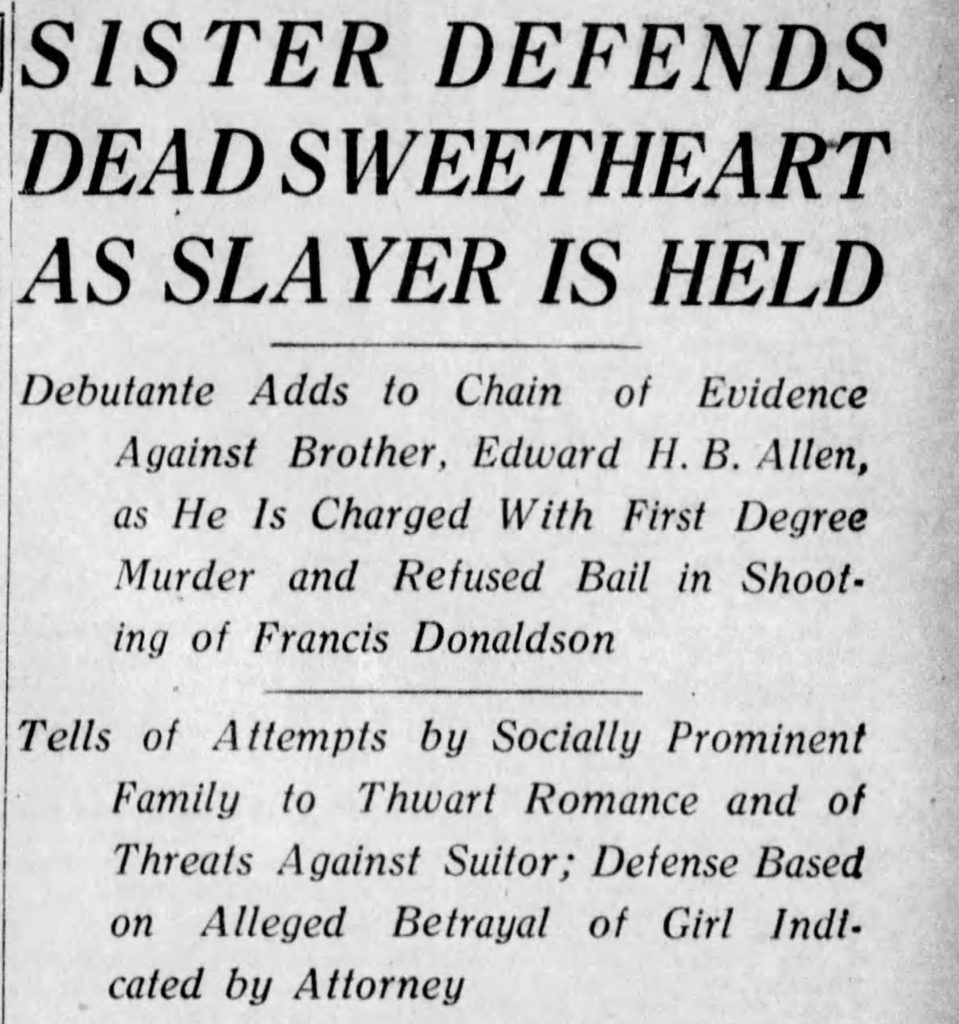
Two days later, Horace released a statement to the newspapers which told of Francis’s deflowering of underage Rose, and claimed that Edward’s action was “an honor killing.” Francis was buried the following morning at West Laurel Hill Cemetery (next to his younger brother, William, who had died of pneumonia 11 months earlier). After the funeral, Francis’s father released a reply to Horace: “A brutal, premeditated murder cannot be exculpated by the futile attempt of a badly advised, distracted father to save his son by hiding him behind the skirts of his daughter, whose character the father himself destroys.”
 
Horace, who was staying along with Rose at the Pearce home in Haverford, collapsed after dinner that evening and had to be carried to bed. A physician was called for, who advised plenty of bed rest, warning that any exertion at all could be fatal. For that reason, Horace did not attend the coroner’s inquest which was held the next afternoon. Rose did not attend either, choosing to spend the day putting together a jig saw puzzle on the Pearce’s sun porch. The coroner found that Francis died as the result of a gunshot that was fired by Edward, who was then officially charged with the crime.


Sisster defends slain fiance


On the day after the shooting, Rose told reporters that her love for Francis was undying and that she would always be in his corner. About Edward, she said “I will not stand by my brother.” She changed her mind a week later though, when she visited Edward in jail and declared to the press that she loved her brother and would do everything that she could to keep him out of the electric chair. 
 
Rose would not be so generous towards her father. On a subsequent visit to the jail with Horace, it was much noted in the newspapers that she did not help him up the steps, refused his hand when it was offered and, refused to speak to Edward in their father’s presence. That evening, Horace once again collapsed and for days after, his life was feared for.
Rose visited Francis’s grave for the first time on November 21, 1931. She placed a sheaf of white roses on the mound of dirt and fell to her knees. Her body quaked as she unsuccessfully tried to hold back her tears.
 
Everywhere Rose went, people stared and whispered. She hated it, and her nerves became frayed. On December 13, 1931, while speeding on the Paoli-West Chester Pike near Berwyn, she could not navigate a sharp curve and her car flipped over onto its side. Rose was not injured and she was able to climb out a side window with the assistance of Patrolman D. E. Hatter, who had been following close behind her. She told Hatter, “I am Rose Allen and I want to get out of this as soon as I can. I am on my way to a dinner party at the home of friends near here, but I’m too shaken to go there now. I don’t want any publicity on this. People would think I’m crazy to turn my car over.” She then cowered behind her flipped car, hiding from the onlooking rubberneckers. She was not issued a ticket and Police Chief Lewis of Berwyn drove her home. Despite her desire for no publicity, the story made it onto page one of the next morning’s Inquirer (along with her photo). After that, Rose went into seclusion. Her feelings towards her father hardened and the only conversation that passed between them was described by a family friend as “acrid at best.”


Slew Sister's Fiance
 
 
Edward’s trial was set for the first week of February 1932. On January 30th, Rose told the Inquirer, “I have been subpoenaed by the Commonwealth, but my story will be the same as if I had been called by the defense. I will answer any question put to me and tell only the truth. I still love Skinny. I would give anything if this hadn’t happened. I feel everything around me is shattered. I am not helping either side in this case. I still love Skinny as much as I ever did, but I am going to tell my story, the way I know it. I will never get over this. I never intend to marry” (before the year was out though, she was dating Kenneth Coolbaugh, whom she married in 1933).
 
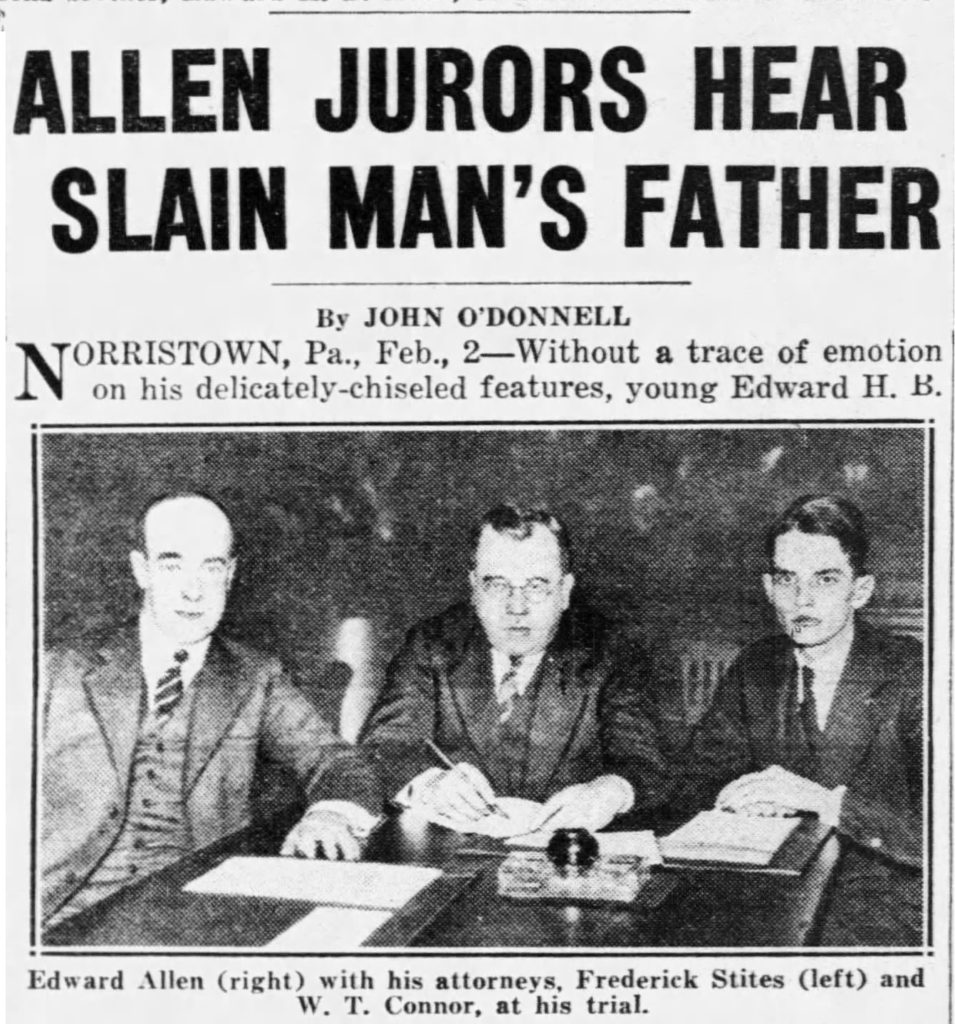
Presiding over the trial was Judge Harold G. Knight. Prosecuting the case was the newly elected Montgomery County District Attorney, Stewart Nase. The defense team consisted of Fletcher W. Stites, John R. K. Scott and William T. Connor (both Stites and Scott were former Pennsylvania state senators). Rose also hired her own attorney, Elmer A. Schroeder, to help with her testimony (Schroeder was the head coach of the U.S. Olympic Soccer team in 1928, 1932 and 1936. He was later elected President of the American Soccer League. He was murdered in his apartment at 47th and Pine streets in 1953.).
 
The jurors were selected on February 1st and 2nd, 1932. One hundred and twenty-five prospective jurors were summoned and seventy-six of them were interviewed before twelve, good persons and true, could be agreed upon. Ten men and two women were selected:
1) George Dewees, 50, Whitemarsh, unemployed laborer (selected as jury foreman), 2) Jacob Markowitz, 39, Pottstown, grocer, 3) Jacob Hertzog Jr., 42, Swedesland, truck driver, 4) Margaret Soay, 50, Willow Grove, housewife, 5) Ellwood Tyson, 54, Royersford, farmer, 6) Howard Hampton, 57, Hampton’s Corner, farmer, 7) John Schlett, 34, Rockledge, salesman, 8) John Szeferski, 39, Conshocken, paper mill laborer, 9) Samuel Kilpatrick Jr., 39, Spring Mill, unemployed gardener, 10) Cora Welker, 43, Pennsburg, housewife, 11) Edwin Bready, 53, Willow Grove, accountant, and 12) Thomas Addy, 40, Norristown, machinist.


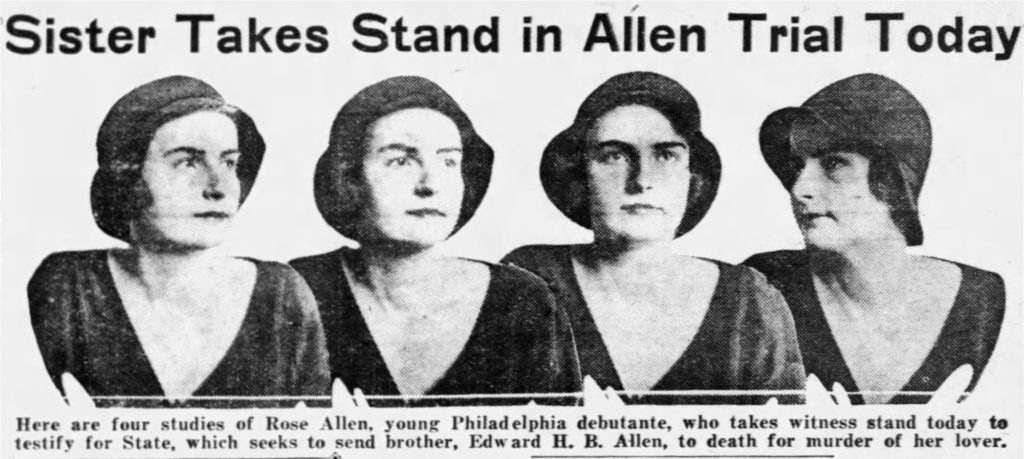
Four Studies of Rose


During the first day of jury selection, Rose was offered a front-row seat in the courtroom next to her father and brother (William), but she declined and instead spent the day in the office of D.A. Nase, reading magazines and a romance novel. At lunch time, Lucas brought her a tray of food and Francis’s father (who sat with Lucas in the courtroom) stopped by to say hello.
 
The trial officially began on February 2, 1932, at 2:40 p.m. Judge Knight had read Rose’s interview in the Inquirer a couple of days earlier, and deemed it most improper. He warned the other 31 witnesses that were subpoenaed to testify not to talk with reporters until after the trial was over. Ten witnesses were called on that first afternoon, including the hospital physicians who worked on Francis and the policemen who responded to the call.
 
When the courthouse opened on the morning of February 3, hundreds quickly stampeded through the doors, knocking down the attendants, in the hopes of getting a seat. The courtroom was filled in moments, leaving 200 still in the hallway and another hundred standing outside. The numbers grew as the day went on and by the afternoon, the crowd stretched for several blocks around the courthouse.
 
Rose was called to testify at noon. As she passed Edward on her way to the witness stand, she gave him a big smile, which he returned with a slight, fleeting smile of his own. Throughout her testimony, she answered in short clipped sentences, constantly biting on her lips (the Inquirer noted that it was “as though she was on guard against saying too much”). She claimed that she and Francis had become engaged sometime in July (though she could not recall the time, the place or the date), and stood up to show his Barge Club pin that she had pinned over her heart (which she claimed he gave her in lieu of a ring). Defense Attorney Connor pointed out that she never mentioned the engagement in her statement to the police at the time of the shooting, nor could any friend or family member recall either her or Francis telling them the happy news. She swore that she told both her father and Edward, but could not recall when or where she did so. She had no problem, though, remembering exactly where and when Edward twice told her that he would “blow off” Francis’s head. In short, her testimony was more about salvaging her own soiled reputation than saving her brother from the electric chair. As she exited the stand, she once again smiled at Edward. This time, he did not smile back. The public held her lack of familial loyalty against her and, for the remainder of the trial, whenever she walked the hallway or outside around the courthouse, she was routinely booed and hissed.
 
After Rose’s testimony, court was adjourned for lunch, during which Juror 12, Thomas Addy, had an aching tooth attended to by a dentist in the judge’s chamber. After lunch, Lucas was called to the stand. During his testimony, he was asked by District Attorney Nase to tell his version of the events leading up to the shooting. According to Lucas, he and Francis were simply peace-keepers on a mission to bring harmony to the Allen household. They wanted nothing more than to restore Rose’s relationship with her father and brother, but were met with foul language and violence. Connor found many discrepancies though in Lucas’s statements and picked him apart during the cross-examination. By the time Lucas left the stand, he was a discredited witness.


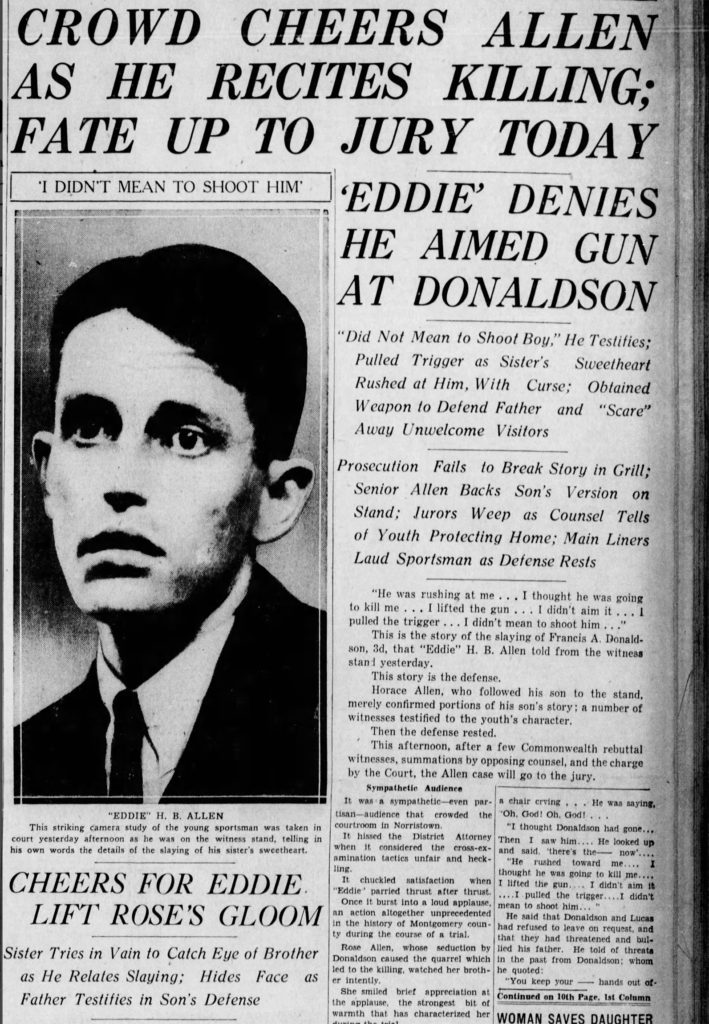
Cheers for Eddie
On February 5, Edward took the stand (for almost 90 minutes) in his own defense. He spoke directly to the jury as he told about how Francis had ruined his sister in Scranton. He spoke about how Francis, at various times, had viciously assaulted all three of the Allen men (and of how they all had feared him). He told about how they (Francis and Lucas) burst uninvited into their living room on the night of the shooting, refused to leave, and roughed up both himself and his father, while trying to dictate how they should run their own household. He said that he never intended to shoot Francis and only meant to scare him, but pulled the trigger instinctively when Francis stepped towards him. 
 
When Edward was done speaking, the courtroom erupted in a loud applause. Whether they supported the “unwritten law” (the right of an individual to avenge family honor) or the “Castle Doctrine” (the right of the individual to protect his home), Edward had won their favor.


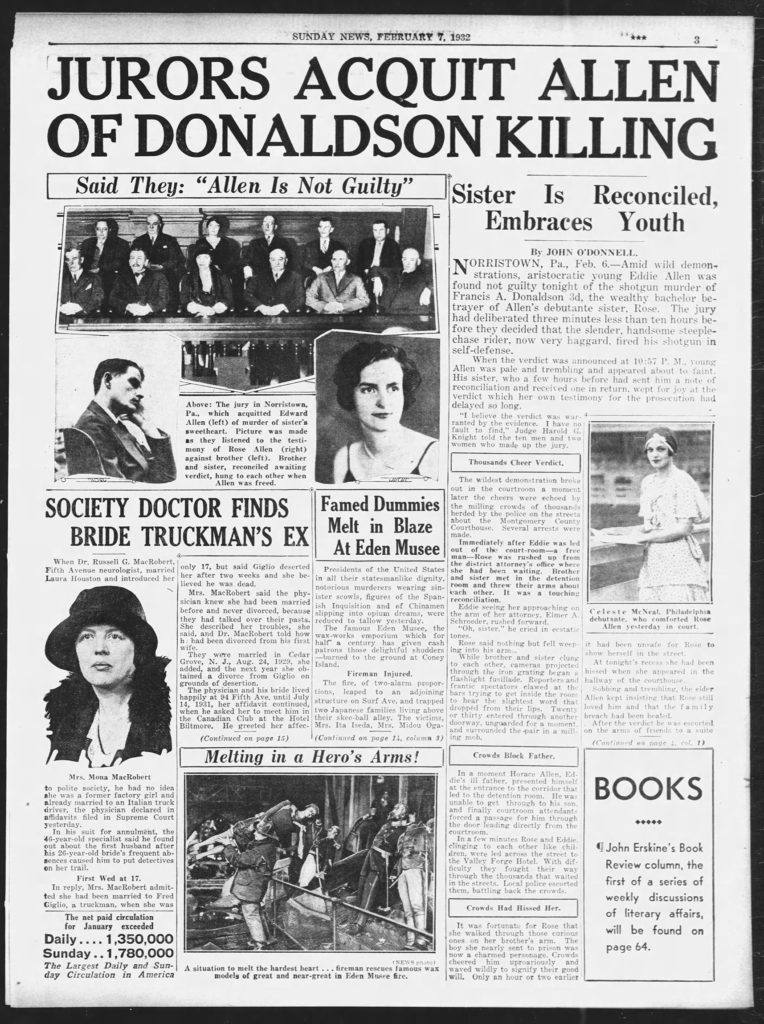
Acquitted


The case went to the jury at 1p.m. on February 6. A crowd of 10,000 “Eddie” supporters jammed the streets around the courthouse, and the police feared a riot if the jury returned with a guilty verdict. After 10 hours and 3 minutes, Jury Foreman Dewees read their decision (almost triumphantly, according to the next morning’s Inquirer); Edward was not guilty on grounds of self defense.
 
Norristown erupted with the blaring of automobile horns and cheers of approval. The verdict was no sooner read when Rose rushed forward into Edward’s arms. He pulled her in tight against his chest, exclaiming, “Oh, Sister!” They were both crying. Edward took out his handkerchief and gently dabbed away the tears from Rose’s cheeks, while he allowed his own tears to run the full length of his face. All that had passed between them was forgiven.
 
About an hour later, Edward literally danced down the courthouse steps to a waiting limousine. Thousands were still gathered to offer their congratulations, and they cheered and waved as the limo pulled away. 
 
Horace, Edward, William and Rose enjoyed a late-night snack at Horace’s newly rented house at 263 Wynnewood Road. In the morning, the four breakfasted together and then Rose drove Edward downtown to do some clothes shopping (he had lost a great deal of weight in jail and needed a new wardrobe).
 
Determined to have the last word and still desperate to salvage her damaged reputation, Rose, while waiting for Edward to have a suit fitted, stopped into the office of her attorney, Schroeder, and drew up a statement that was released to the press the next day. In her missive, Rose once again declared her undying love for Francis, praised his parents as being wonderful people, defended Lucas, who had been vilified in the press (one paper called him a “meddling gorilla”) and avowed that she would never again make any public statements regarding Francis or her relationship with him.


Rose must have been mortified on August 27, 1932, when the MGM movie “Unashamed” opened at the Stanton Theater (16th and Market). As the Inquirer reviewer pointed out the next morning, the script was clearly a familiar story: “After tapping and overtaxing the resources of most of the stories which have ever been written, the movies have lately turned to
real life for the generation of their plots.
 
Apparently, this is exactly the case of “Unashamed” the new film at the Stanton. A recent suburban county murder case has been paralleled almost event for event in this new film.” 
 
The film received good reviews and starred Helen Twelvetrees as Rose, Robert Young (later played Marcus Welby) as Edward, Monroe Owsley as Francis, Jean Hersholt as Mr. Donaldson, Robert Warwick as Mr. Allen, Louise Beavers as the Allen’s maid, John Miljan as District Attorney Nace, and Lewis Stone (later played Mickey Rooney’s dad in the Andy Hardy series) as Defense Attorney Connor (of course, all of the names were changed to protect the innocent).


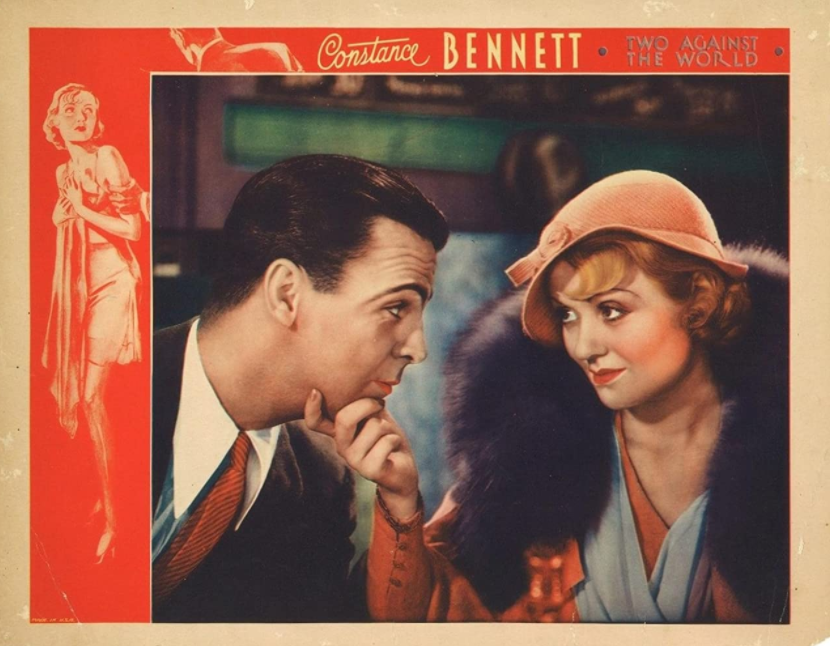
Two Against the World

One week after Unashamed opened, Warner Brothers released their own version of the Allen trial, “Two Against the World” starring Constance Bennett. Horace unsuccessfully tried to block the production of the movie when it was first announced six-weeks after the trial concluded. He needn’t have worried though. In true Warner’s fashion, they sacrificed historical accuracy for a sensationalized plot and so by the time it hit the theaters, it bared little resemblance to the actual events and characters.

 
The Aftermath:
The Donaldson Family: After the trial, Mr. Donaldson criticized the outcome. He thought that Judge Knight did an awful job presiding, and did not think the verdict was fair. With the death of Francis, the Donaldsons were now childless, having lost their younger son William in 1930, to pneumonia. Mr. Donaldson died on February 23, 1944, and Mrs. Donaldson on April 18, 1950. The Francis A. Donaldson and Son Insurance Agency continued until the sudden death of Donaldson’s business partner, C. Carroll Knight, in 1957.
 
The Allen Family: Horace Allen never regained his health and died from heart disease on July 25, 1933, at age 56 (he easily looked 20 years older). One month later, Edward, William and Rose received $85,000 (equal to $1.64 million today), their father’s share of the trust fund. The entire trust would become theirs upon the death of their Aunt Kate, who was still living at the Gladwyne Colony Insane Sanitarium.
 
Edward Allen laid low for about a year after the trial, but then got back into horse racing, mostly at Wissahickon Farms with the Philadelphia Riders and Drivers Club. By 1935, after a series of bad falls from the saddle, Edward was an invalid.
 
Over the next two years, he endured 15 operations to correct various internal injuries and then traveled to South America to recuperate. Upon returning to West Palm Beach, Florida in January 1937, Edward was hospitalized with tropical fever. He died on February 4, 1937, at age 28.
 
William Allen became an alcoholic. On October 5, 1932, he stole Rose’s car and purchased a pint of bathtub gin. After imbibing half of the bottle, he became quite blotto. At 30th and Walnut, he skidded on wet trolley tracks and smashed into a milk wagon, injuring the driver. The police lab analysis of his hooch showed that it contained enough isopropyl alcohol to blind him, had he had time to drink the entire bottle. William was arrested and was released on $600 bail.
 
Then, just three days later, again drunk, he stole Edward’s car. At 59th and Overbrook, he sped through a red light and nearly struck two Philadelphia motorcycle cops. They chased him for a mile before catching him. Again, he was released on $600 bail.
 
Ten days later, he was arrested by the Lower Merion police for causing a drunken disturbance in front of his father’s house (trying to take Horace’s car for a drive). On December 22, 1932, William was sentenced to 30 days in Moyamensing Prison and two years probation. In 1935, he retired (at age 23) and moved to West Palm Beach, Florida. 
 
In March 1939, he married Virginia Hammett, the 17 year old daughter of a bricklayer. The marriage only lasted nine months. During the same week that they divorced, William suffered two heart attacks. In a letter to his lawyer (also dated that week), he mentioned that he was in desperate circumstances.
 
Despondent, on November 19, 1939, he went for a swim (against doctor’s orders) off of Stock Island in Key West. He had another heart attack while swimming and drowned. His body was found the next morning, washed up on the beach. Like Edward, he was just 28 years old.
 
Two weeks after the trial ended, Rose moved out of her father’s house and into an apartment near 40th and Locust. She took a job working in a dress shop at 4024 Chestnut Street. Despite having pronounced that her love for Francis was undying and that she would never get married, Rose was soon dating Kenneth Coolbaugh of 228 Avon Road in Merion. Their engagement was announced in March 1933. Rose reconciled with her father (who gave his blessing) and, when it became obvious in mid-July 1933, that he did not have a lot of time left, she quickly set the date for July 29. Sadly, Horace died four days before the happy day. All three of his children were with him when he passed.
 
Rose went ahead with her wedding on July 29, 1933 (two days after her father’s funeral). It was a small ceremony, held in the Coolbaugh home, with just a dozen friends and family in attendance. She did not invite either of her brothers (but she did invite Gal Lucas). Rose and Kenneth moved to 413 Grove Place in Narberth and by the end of September, they were expecting a child. Rose gave birth to a daughter, Carolyn Whitaker Coolbaugh, on June 30, 1934. The baby died eight days later from excessive diarrhea. On June 10, 1936, Rose gave birth to a son, Ronald G. Coolbaugh. Soon afterwards, they moved to 300 Woodside Avenue, Narberth.
 
Aunt Kate died on April 5, 1938. It was announced that two-thirds of the remaining trust belonged to Rose (Edward had left her his share when he died the previous year) and one-third was going to William. Two months later, Rose flew to Reno, Nevada, where she obtained a divorce from Kenneth on grounds of extreme cruelty, habitual drunkeness and non-support. The divorce was finalized on August 2, 1938.
 
Barely before the ink was dry, Rose was pregnant with the child of her investment broker/lover, Richard K. Thomson of Brainard, New York, whom she married in Elkton, Maryland on November 19, 1938. Rose gave birth to their son, Richard Jr. in May 1939. Rose and Richard’s first wedding anniversary was on November 19, 1939, the same day that her brother William died. Rose was his sole beneficiary; all of Grandfather Benjamin’s trust fund was now hers. By 1940, they moved to Righter’s Mill Road in Penn Valley. In 1941, Rose gave birth to another son, Edward. 
 
In 1942, Rose developed serious problems with her heart and liver. Her marriage to Richard fell apart in 1944 and in September of that year, she started divorce proceedings. Richard relocated to Leominster, Massachusetts while Rose and the children moved to 403 Wellesley Road in Mount Airy. Rose suffered from insomnia, for which her physician, Dr. E. C. Towne of Narberth, prescribed a mild sedative.
 
On March 12, 1945, Rose was at home with her sons: Ronnie (8), Richie (5) and Edward (3). She was not feeling well as they ate lunch and excused herself, telling Ronnie to clean up the dishes and to mind his brothers while she rested for a little bit. Rose went to her room, washed back a sedative with highball of Scotch and nestled in under her blanket. By 9:30 that evening, the boys were hungry and needed to eat. Ronnie went into Rose’s room and shook her arm. She would not budge. He shouted at her, “Mommy, Mommy, Mommy, wake up!” Again, he got no response. He phoned the operator and told her, “My name is Ronnie. I can’t get Mommy awake.” The police arrived minutes later and found Rose on the bed in the upstairs front room, dead at age 31.
 
The children were taken overnight to the House of Detention. The next morning, Ronnie was claimed by an aunt, Mrs. Nelson Billingham of 228 Avon Road. His father, Kenneth Coolbaugh, was in the army waiting to be shipped overseas. Richie and Eddie were claimed by Mrs. N. L. Jeffries, who owned the dress shop where Rose worked in 1932. She kept them until their father, Richard Thomson, arrived from Leominster. 
 
The autopsy and toxicology report showed that Rose died from an accidental overdose. Neither the sedative or the amount of liquor in her system were lethal levels, but combined with her body chemistry (due to her liver disease), it was more than she could handle. Acute anoxia developed and her brain starved of oxygen.
 
In her will, Rose left everything to her three sons. Her estranged husband, Richard Thomson (she had not yet finalized the divorce), contested the will, and on December 22, 1945, he was awarded one-third of her estate by Judge Grover Ladner in Orphans’ Court. The remainder was placed in trust for the boys, who each received their share upon reaching the age of 21.
 
Today, the Allen Family rests together in Ivy Hill Cemetery. The Donaldson Family rests together in West Laurel Hill Cemetery.
 
Regarding the Green Hill Farms Hotel where the shooting took place: The land was once part of “Greenhill,” the estate of Israel Morris. Israel’s great great grandson was Morris Wood, who built the Green Hill Farms Hotel in two sections, the first in 1919 (designed by Horace Trumbauer) and the rear portion in 1929. The Allen apartment, C-2, was located in the newer rear portion. 
 
The earlier building was sold in 1939 and became the Eastern Baptist Theological Seminary. Today it has been converted into a 110 luxury apartment complex called “The Palmer.” The newer building, where the crime was committed, became a residential hall for students of the Lankenau Hospital School of Nursing. It closed in 1992 and was razed in 1994. Today it is a parking lot in front of Saunders House, a not-for-profit nursing home.

Filed Under: History Tagged With: Bryn Mawr College, St. Charles Seminary, Wynnewood

Reader Interactions

Trackbacks

  1. In the 1920s, Main Line Society Gathered In Wynnewood At The Elegant, But Scandal-ridden Green Hill Farms Hotel - This Is Lower Merion And Narberth says:
    March 15, 2021 at 9:51 am

    […] After getting busted by the “Probies” in 1925, until the fall of 1931, things at the Green Hill were just fashionably dull. Then came the night of  November 9, 1931. […]

Primary Sidebar

Sports

Family Learning To Luge

Want to Try Luge? From Lower Merion, It Starts With a Drive to Lake Placid

I was watching the Luge on NBC over the weekend. I thought it was boring, especially when juxtaposed against the more dramatic events, like curling.  The color commentator kept explaining how each “slider” was doing something slightly better or worse than the others, but to my untrained eye, they all looked the same: feet first, […]

Arts and Entertainment

January 16-18: The Philly Pen Show — A Delightfully Analog Experience

f you’re looking for a break from screens, alerts, and endless scrolling, the Philly Pen Show might be the cure—at least temporarily. It’s an unapologetically analog event: pens, paper, ink, and the people who still care deeply about them. Whether you’re a serious collector, someone who misses the feel of writing by hand, or just […]

Hoots and Hellmouth at Bryn Mawr Gazebo

Bryn Mawr Gazebo Rocks To Hoots and Hellmouth

https://youtu.be/YOkPbgp7nII?si=YTr-Zo0vInLyPDa_ Music fans in Bryn Mawr were treated on Saturday night (July 20) to a high-energy performance by the Philadelphia band Hoots and Hellmouth. On several occasions, the group brought the audience to its feet by playing a mashup of music styles, including folk, gospel revival, blues, pop, and rock.

Trouble with Angels

Opening Shot Of 1966 Movie ‘The Trouble With Angels’ – At Merion Station

https://youtu.be/gaOBPM7unGg?si=6OSbdDO6ztY4nNLZ In 1966, when the movie “The Trouble With Angels” was filmed, a crew came to Merion Station to shoot a 12-second scene.  

More Posts from this Category

© 2019–2026