My first exposure to Louis Kahn’s work was when I entered Harriton High School as a Sophomore in September of 1965. I recall seeing what, at that time, seemed to me to be a very strange-looking building on the campus of Bryn Mawr College.
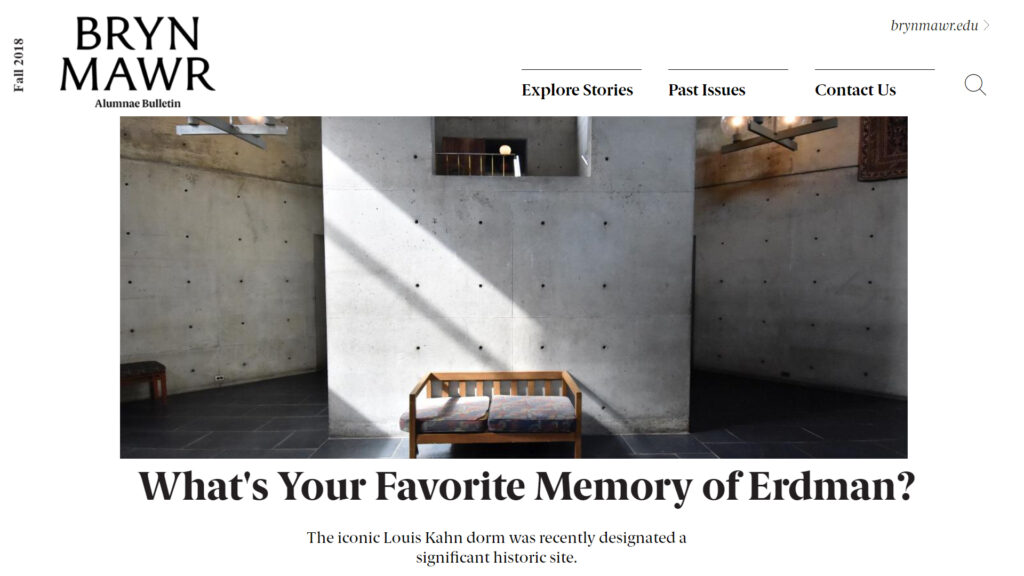
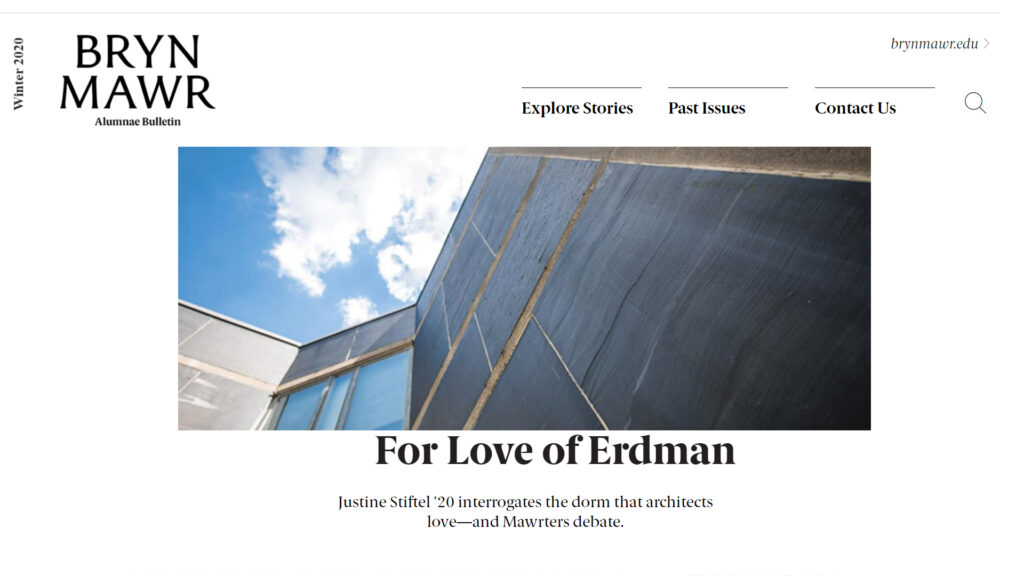
What captured my attention was the, just opened, Erdman Hall Dormitory, which overlooked Morris Avenue, near Montgomery Avenue.
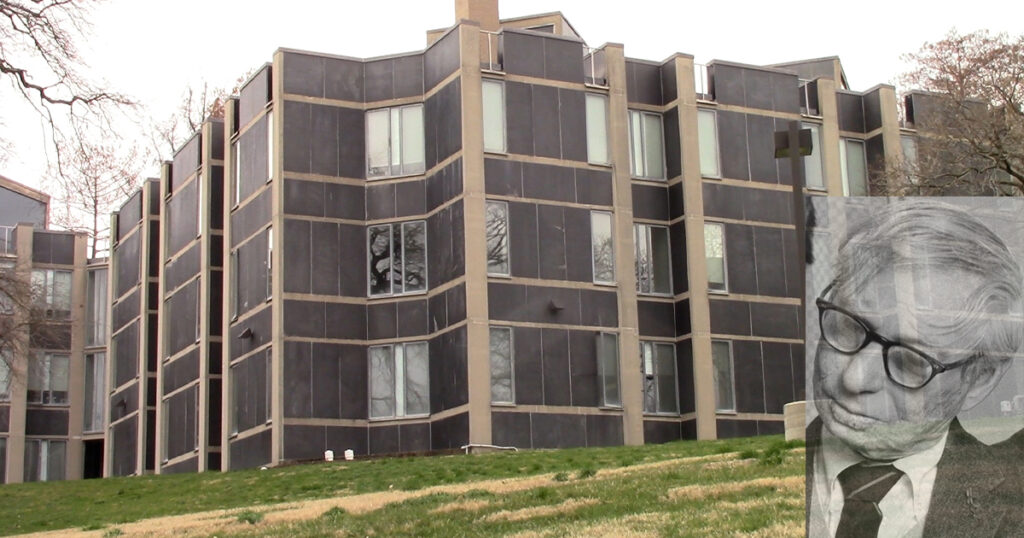
I can’t say that for Edrman and me that it was love at first sight.
I didn’t know what to make of it. I thought my ultra-modern Vincent Kling- designed Harriton High School (opened in 1957) was “pretty cool-looking.”
And before Harriton, I spent three years at the just-as-modern Welsh Valley “Junior High,” (designed by Harbeson, Hough, Livingston, & Larson), which also opened in 1957. I thought Welsh Valley was also “pretty nice.”
The difference between Harriton/Welsh Valley and Erdman was that my two schools blended in “comfortably” with the “new-style houses” that dotted the hillsides and cul-de-sacs in Penn Valley and Gladwyne.
“That thing” at the college was another story. Among the many stately buildings at Bryn College, it stood out (to my adolescent sensibilities) like a sore thumb.
My mother told me that it was designed by “a very famous architect.”
Years went by. Decades passed. Occasionally I drove past Erdman on the way from here to there – and whenever I did, I would always make a mental note – famous architect. Eventually, through osmosis, I learned that Louis Kahn was the famous architect.
In 2019, I did a piece for this website called “Important Architecture In Lower Merion And Narberth.”
I learned then that in addition to Erdman Hall, Kahn also designed two houses in Lower Merion. So I decided not to include any of his buildings for the “Important Architecture” story, thinking I would do a separate article about all three of his buildings.
Googling for more information about Erdman, I found Wendy Lesser’s excellent biography of Kahn – “You Say To Brick.” I also re-watched “My Architect,” a compelling 2003 Oscar-nominated documentary about Louis Kahn, made and narrated by his son, Nathaniel
Neither Nathaniel Kahn nor Lesser attempted to whitewash the complicated aspects of Louis Kahn’s personal life. The short version of “the complicated” is that Louis Kahn was a serial womanizer.
Nathaniel Kahn’s mother was Harriet Pattison. She was a landscape architect (28 years younger than Kahn) and collaborated with him on several projects, but being married to one another wasn’t one of those projects.
Kahn’s other out-of-wedlock child is Alexandra Tyng, the daughter of Anne Tyng. Anne Tyng worked as an architect at Kahn’s firm and collaborated closely with him from 1945 until 1964.
About Kahn and Tyng and Erdman Hall – Lesser wrote – It [Erdman Hall] was the last project he attempted to design in tandem with Anne Tyng, and perhaps the fraying of their personal relationship lay behind some of the problems. Tyng, with her usual penchant for precise geometry, wanted the bedrooms to be octagonal in shape, nestled together in a kind of molecular design around the circumference of the building. Kahn preferred a pattern of interlocking Ts and rectangles, with some rooms having a wide outside window and some only a narrow one. In Anne’s design, the college girls’ rooms would all have been equal; in Lou’s, some were obviously more desirable than others. At each meeting with the Bryn Mawr administration from 1960 onward, Lou and Anne would come equipped with their competing schemes, which they would then present, argue for, and revise before the next meeting. The conflict was overt, and it didn’t just affect the client. “There were two teams, the Anne Tyng team and the Lou Kahn team,” Richard Wurman said about office life during that period. “It was horrible to be in the office then.” Finally, sensing everyone’s impatience and discomfort, Lou told Anne that the era of competing schemes was over: only one design would be presented at each Bryn Mawr meeting, and it would be his. From that day forth, she ceased to participate in the project at all.
Esther Kahn was the only woman to whom Louis Kahn was ever married. They had a daughter, named Sue Anne.
Nathaniel Kahn and Alexandra Tyng were both born, while Louis Kahn was married to Esther. Esther and Louis Kahn remained a married couple until he died in 1974.
Alexandra Tyng lives in Narberth now, and is an accomplished artist in her own right.
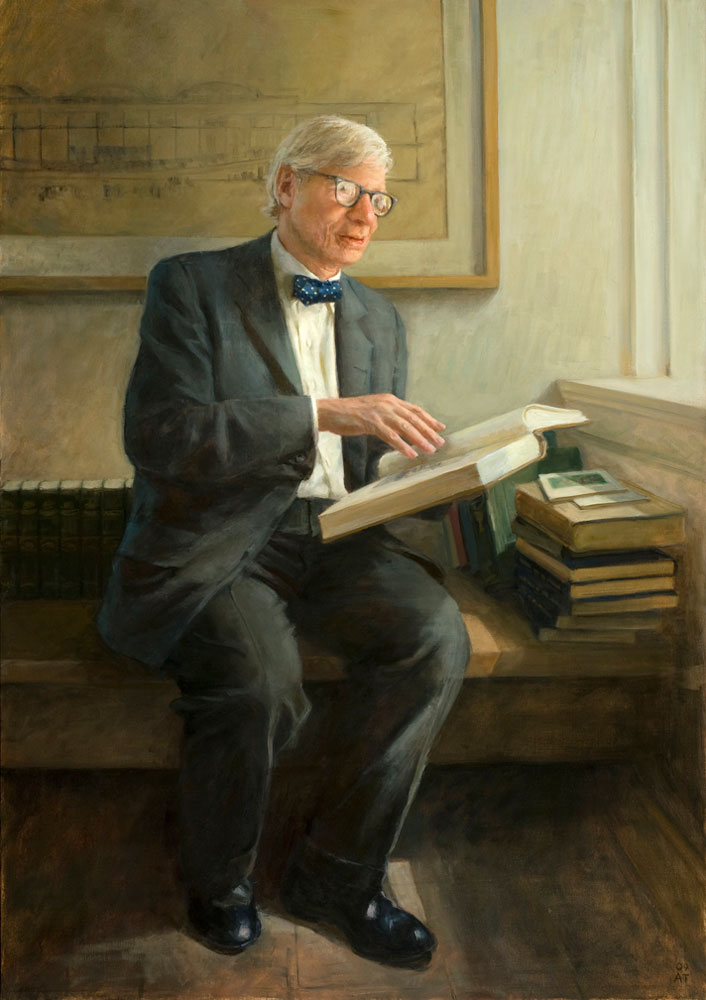
Portrait of Lewis Kahn by his daughter Alexandra Tyng – National Portrait Gallery
A scene in “My Architect” in which, for the first time, the three half-siblings discuss families, together.
So What’s The Big Deal About Louis Kahn?
In April of 1966, not even a year after Erdman Hall opened, the Museum of Modern Art in New York (MOMA) thought enough of him to present an exhibit exclusively featuring Kahn’s work (The Architecture of Louis Kahn). In their press release, MOMA wrote that Kahn “is considered one of the most influential living American architects.”
In 1992 MOMA presented a retrospective of Kahn’s work. It was called “Louis J. Kahn: In The Realm of Architecture.” This time the museum described him as “one of the great architects of this century.”
See, my mother was right.
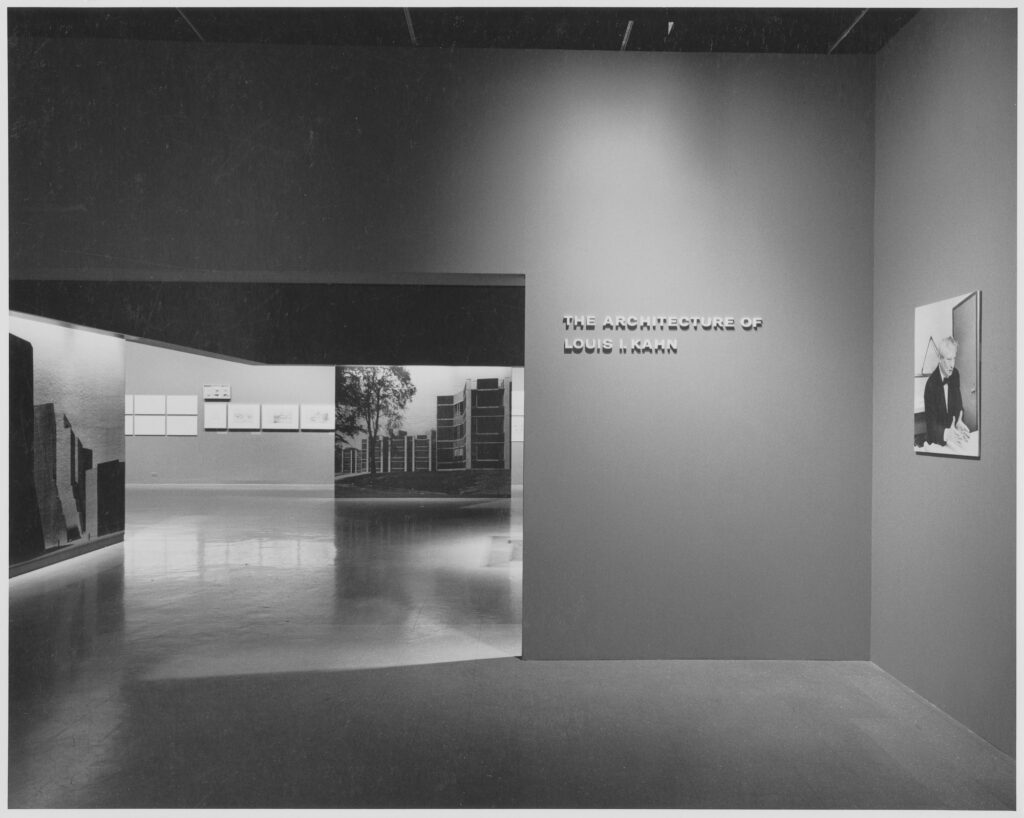
Erdman Hall featured as part of Moma’s 1966 Louis Kahn exhibit.
In “My Architect,” Nathaniel Kahn spoke with some of the giants of architecture, most of whom were effusive in their praise for his father.
Comparing himself to Kahn, I.M. Pei said, “three or four masterpieces is more important than 50 or 60 buildings – quality, not quantity.”
Philip Johnson described Kahn as “the most beloved architect of our time … Frank Lloyd Wright was too cantakerous to love, Mies Van De Roe – you couldn’t talk to him at all, Corbusier was mean, but Lou – there was a man … all my buildings don’t add up to his three or four buildings.
Frank Gehry (who designed the recent expansion and renovation of the Philadelphia Art Museum, said of Kahn, “I think he had trouble because he was a mystic. And he wouldn’t be able to talk the lingo of the business world. You know, architecture is so passionless in the Modern Movement. There was no sense of … I mean it was all mechanical. And that’s why the Post Modern thing happened – because people couldn’t handle it. It was just so cold and formalist. And Lou was kind of the breath of fresh air in that. I mean in America. And my first work came out of my reverence for him.”
On the other hand, Edmund Bacon, who was Director of the Philadelphia Planning Commision, and according to his New York Times obituary “had an impact on his native city that some have compared to that of Robert Moses during his long reign in New York” – was not a fan of Kahn. In “My Architect” Bacon is seen smirking and can be heard “explaining” in a 1967 documentary that “I repeatedly made the effort to involve Lou in our work in Philadelphia, but it’s turned out that the special quality of his genius could not be brought together with the reality of the problem.”
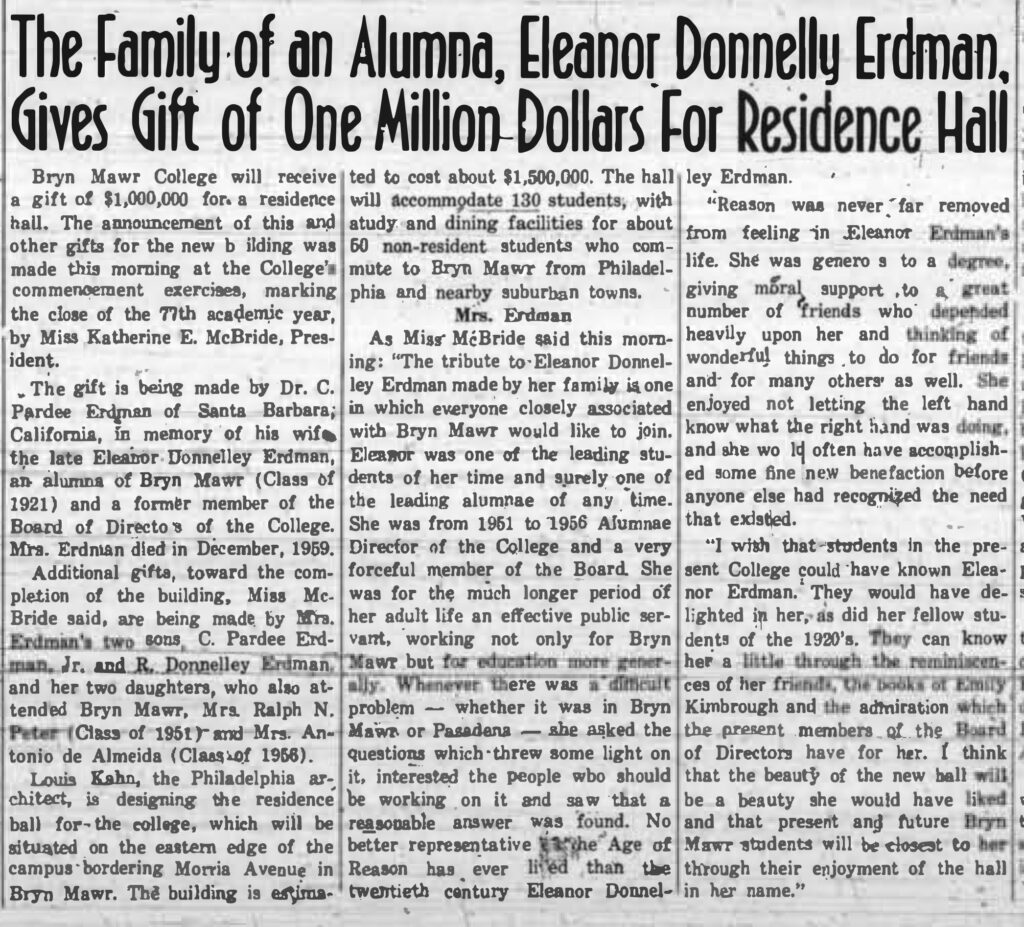
Bryn Mawr College News – June 1962
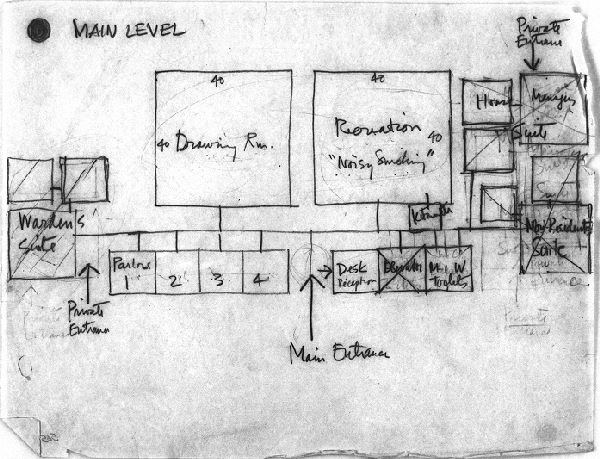
Kahn’s sketches for Erdman Hall – Source: Philadelphia Architects and Buildings
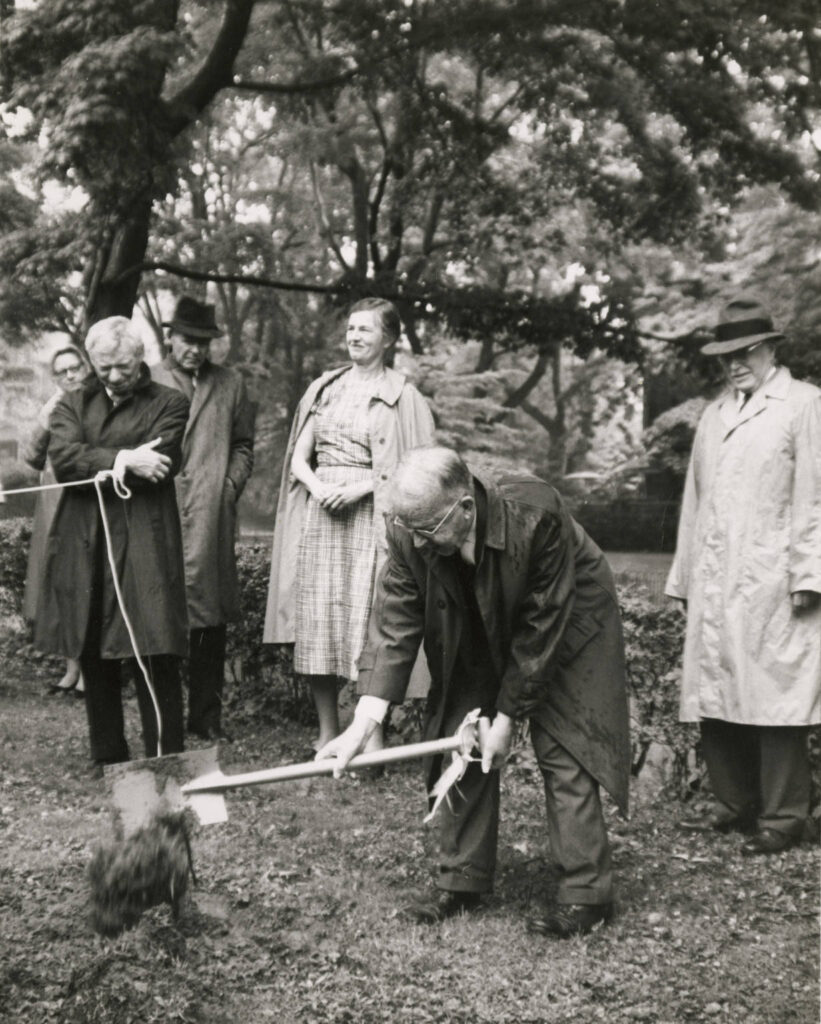
Erdman Hall Ground Breaking -1963, Bryn Mawr College Archives
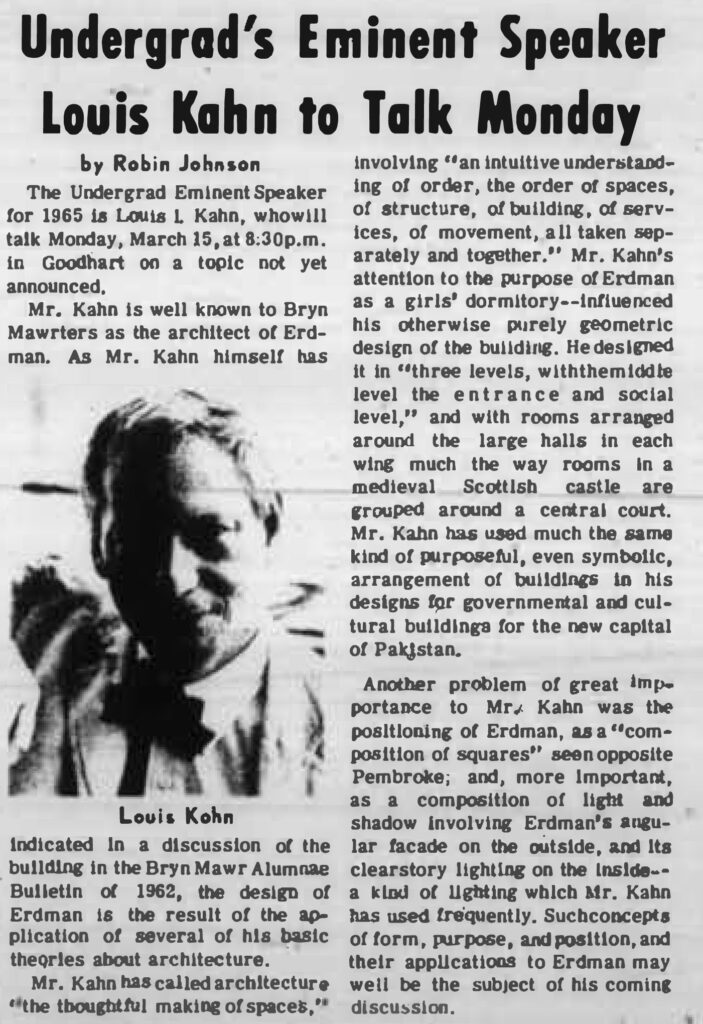
Kahn to Speak On Campus, March 1965 – Bryn Mawr College News
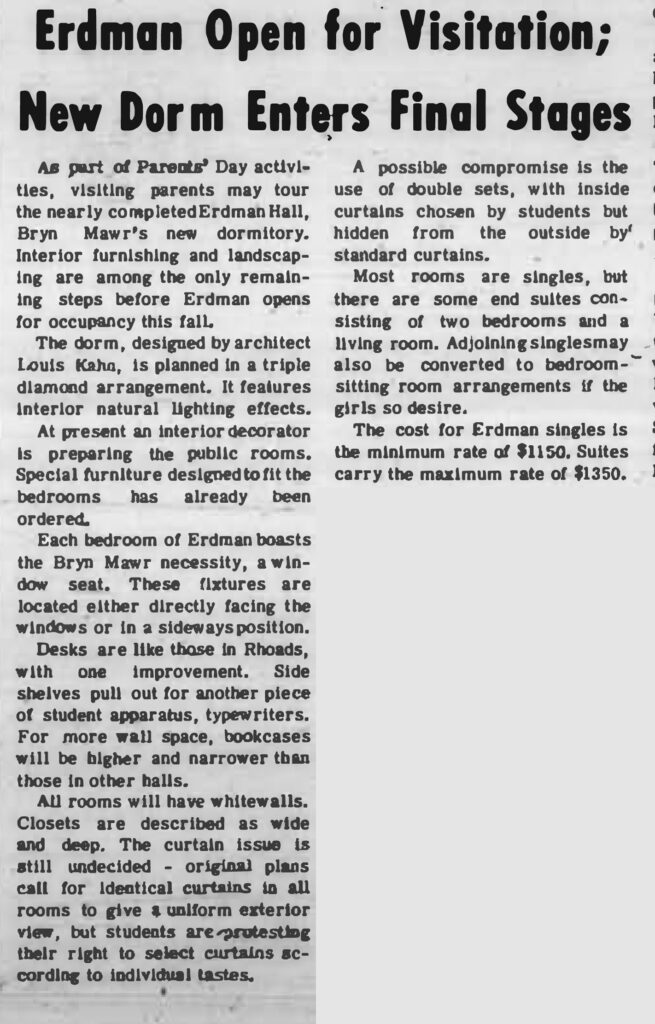
April 1965 – Bryn Mawr College News
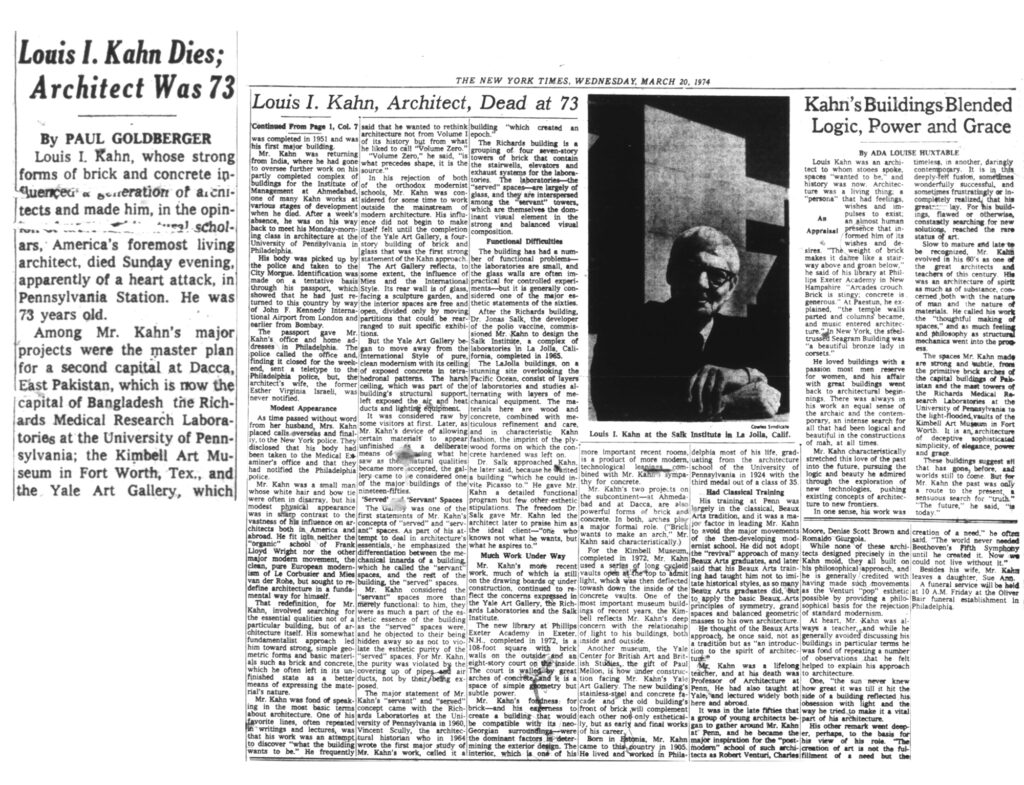
Louis Kahn Obituary, New York Times, 1974
1992
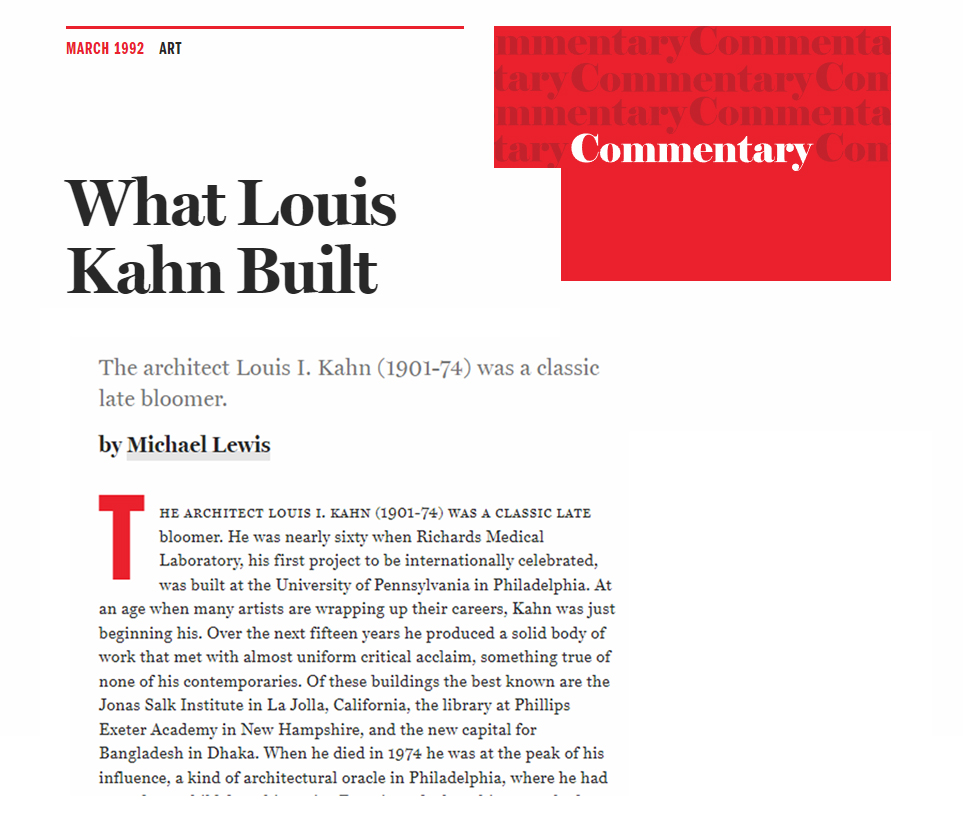
Above – by using solid and substantial materials, by bathing these materials in natural light, by making monumental spaces out of abstract geometric forms, and, above all, by once again making architecture serious and solemn. In short, Kahn found a modern architecture that was essentially functional and gave it an inspirational dimension. This is a restoration myth, with Kahn cast in the epic role of the restorer.
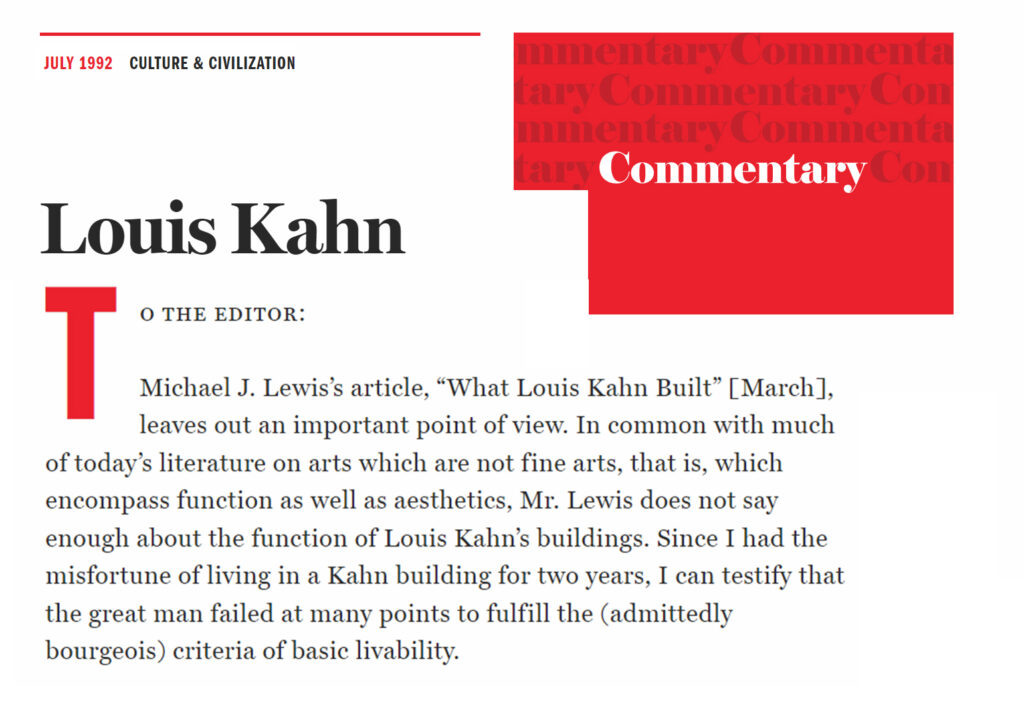
Below – Since I had the misfortune of living in a Kahn building for two years, I can testify that the great man failed at many points to fulfill the (admittedly bourgeois) criteria of basic livability.
When I was first assigned a room in Erdman Hall at Bryn Mawr College, I looked forward to living in a building of unique design. When I found that the architect was considered a living legend (this was 1972), about whom the students had a corpus of anecdotes, my interest was piqued even further. It was with intense dismay that I discovered the shortcomings of his building.
If you like this story, please share it.