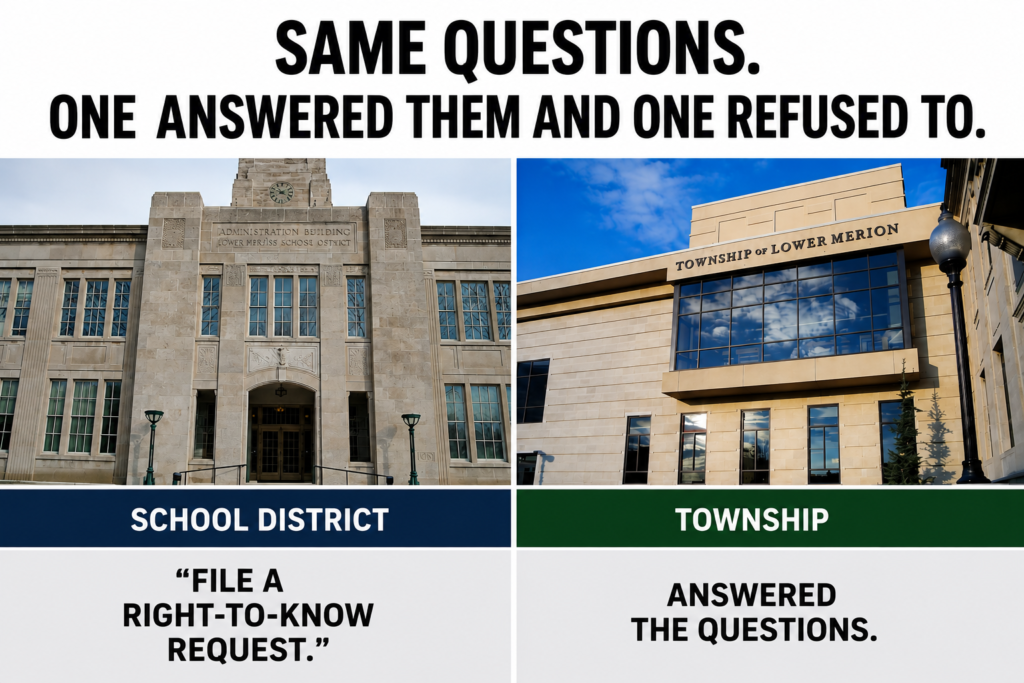
Lower Merion Township answered questions about the police consultation (or lack thereof) before moving the School Board meeting from in person to Zoom. The Lower Merion School District told me to file a Right-to-Know request.
What I Asked
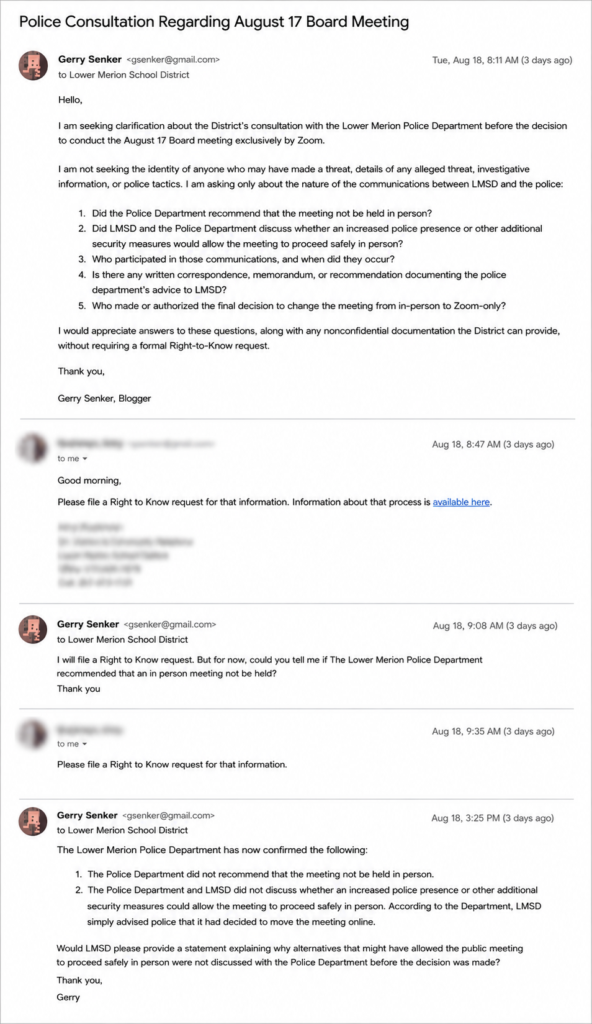
After the Lower Merion School District moved its August 17 School Board meeting from in-person to Zoom-only, I asked the District some basic questions about its consultation with the Lower Merion Police Department:
Did the Police Department recommend that the meeting not be held in person?
Did the District and Police Department discuss whether increased police presence or other additional security measures would allow the meeting to proceed safely in person?
Who participated in those communications, and when did they occur?
Was there any written correspondence, memorandum or recommendation documenting the Police Department’s advice?
Who made or authorized the final decision to change the meeting from in-person to Zoom-only?
The School District’s Response
The School District did not answer the questions.
Instead, I was told:
“Please file a Right to Know request for that information.”
I followed up by asking just one of the questions:
“Could you tell me if the Lower Merion Police Department recommended that an in-person meeting not be held?”
Again, I was told:
“Please file a Right to Know request for that information.”
The Township’s Response
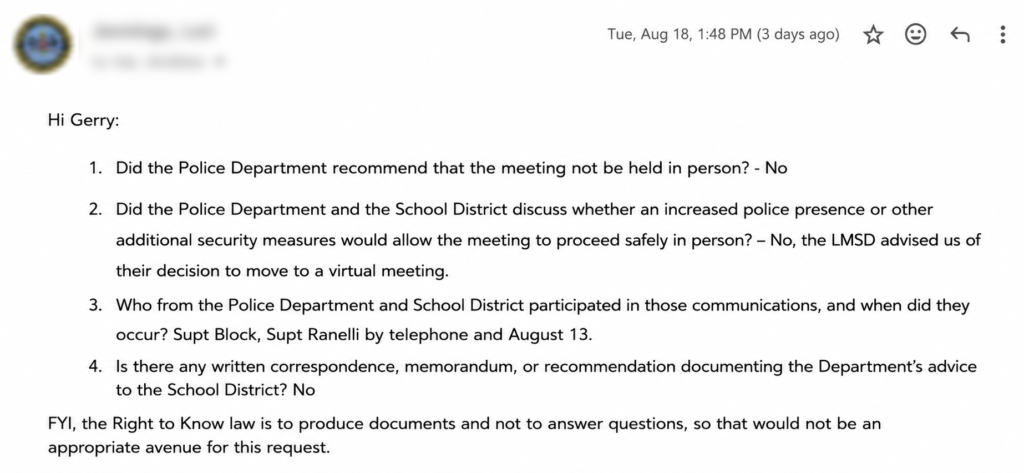
I asked Lower Merion Township substantially the same questions.
The Township answered them.
Did the Police Department recommend that the meeting not be held in person?
No.
Did the Police Department and School District discuss whether increased police presence or other additional security measures would allow the meeting to proceed safely in person?
No. The School District advised police of its decision to move to a virtual meeting.
Who participated in the communications, and when did they occur?
The police superintendent and school superintendent spoke by telephone on August 13.
Was there any written correspondence, memorandum or recommendation documenting the Police Department’s advice to the School District?
No.
The Township also explained:
“The Right to Know law is to produce documents and not to answer questions, so that would not be an appropriate avenue for this request.”
One More Question
Did the Director of School & Community Relations consult with either the School Board president or the superintendent before deciding not to answer these questions and instead directing me to file a Right-to-Know request?
Or was that decision made by the Director of School & Community Relations alone?
Which response would get the higher grade from the Strategic Communication professors at Northwestern’s Medill School of Journalism—the Township’s or the School District’s?