Within Months, an Inquirer News Blackout Threatened the Team’s Existence
Sixty-three years ago tonight, professional basketball came back to Philadelphia. On Saturday, October 19, 1963, the Detroit Pistons beat the brand-new Philadelphia 76ers 124–121 at Convention Hall. Lee Shaffer led the Sixers with 31 points, and Chet Walker added 24. It wasn’t their debut. Three nights earlier they had opened on the road with a 117–115 win in Detroit, with Hal Greer scoring 26. But it was the night Philadelphia got to see its new team.
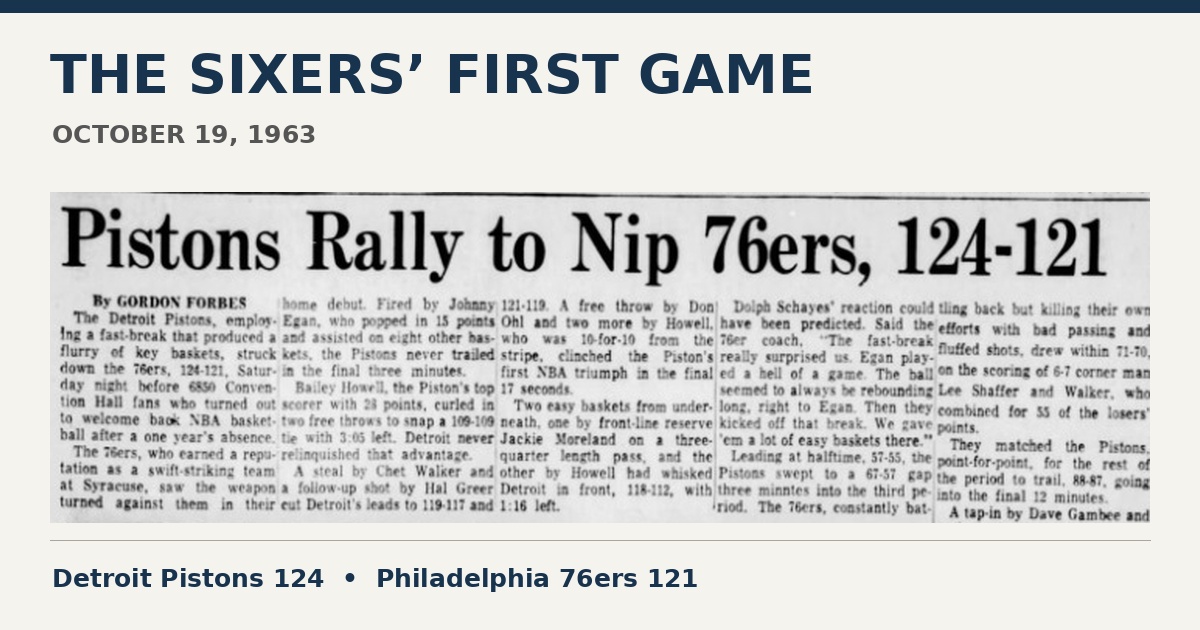
The city had been without a team for a year. The Warriors, and Wilt Chamberlain, had been moved to San Francisco after the 1961–62 season.
The Team From Syracuse
The 76ers didn’t start in Philadelphia. They started as the Syracuse Nationals. Danny Biasone bought the Syracuse franchise in the National Basketball League in 1946, reportedly for $1,000, and the Nats joined the NBA three years later. Biasone owned a bowling alley. He is also credited with co-inventing the 24-second shot clock with Leo Ferris, which may have saved the league from its own stalling tactics.
The Nationals were good. They reached the NBA Finals in 1950 and 1954, losing both times to the Minneapolis Lakers. They finally won the title on April 10, 1955, beating the Fort Wayne Pistons 92–91 in Game 7. They had winning records in 11 of their 14 seasons in Syracuse. Their star was Dolph Schayes.
Small-market economics caught up with them anyway. When Biasone sold the club in May 1963, he put the price at $500,000. He said the Nats had lost $20,000 the previous season and he expected to lose $100,000 the next.
Kosloff and Richman
The buyers were two friends from South Philly. Ike Richman met Irv Kosloff at South Philadelphia High School, and they stayed lifelong friends. Kosloff had founded the Roosevelt Paper Company in 1932. Richman was a lawyer. He had been general counsel for the Philadelphia Warriors from 1948 to 1962 and was Wilt Chamberlain’s personal attorney.
It was Richman who wanted to acquire the Nationals. He persuaded Kosloff to put up the purchase price, which was between $500,000 and $600,000, and Richman became the operating head of the franchise. Kosloff, busy with his paper business, stayed the silent partner. According to the Inquirer, Kosloff had planned to split the team among eight other shareholders. Nobody else signed on, so the two men owned it themselves.
The NBA approved the move on May 22, 1963, and the name change on August 6. Schayes became the first coach. He later said the roster was loaded at forward and his knees were bad, so the owners asked him whether he wanted to coach.
The Blackout
The new team had a problem: the city’s biggest newspaper barely covered it.
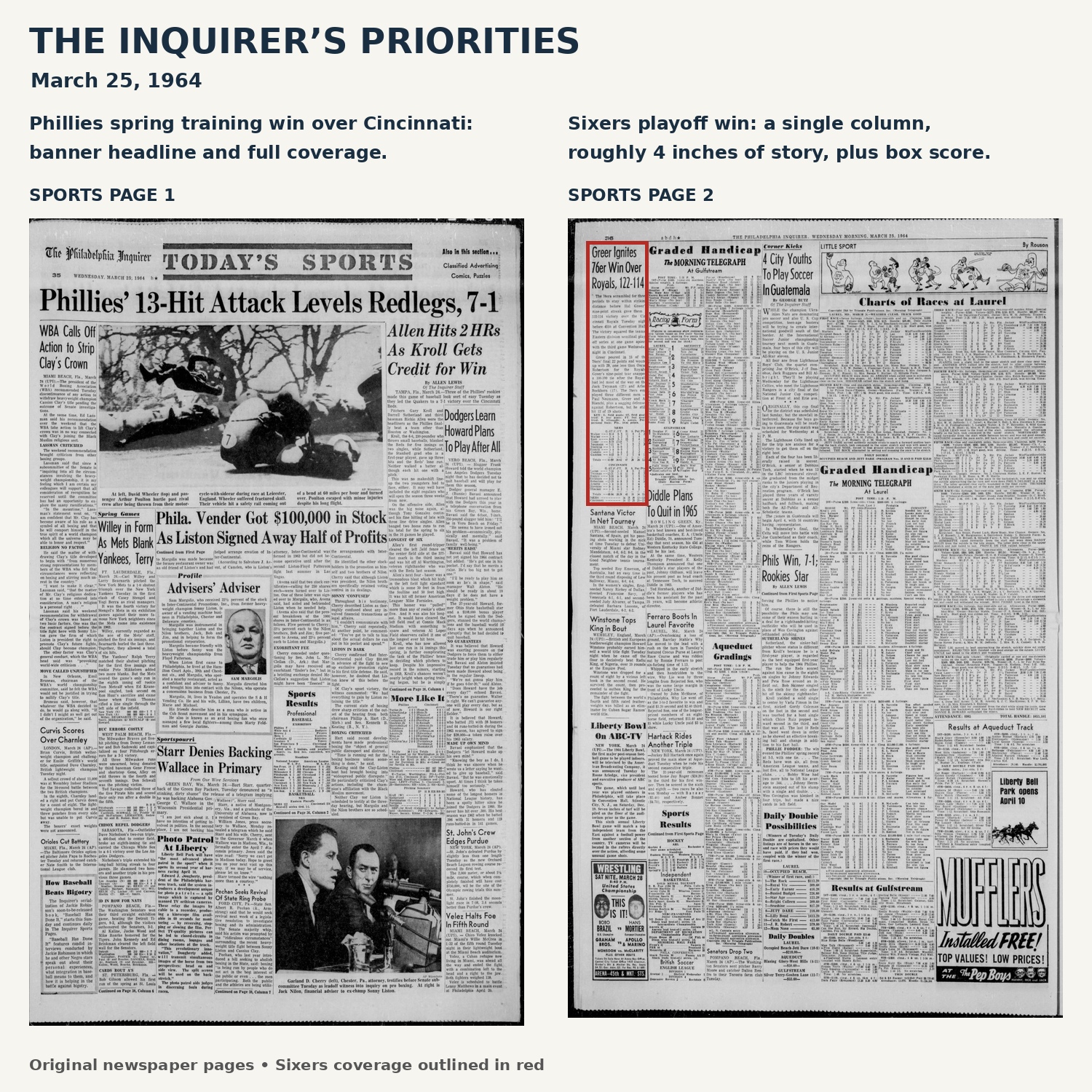
On March 25, 1964, the Inquirer’s sports page carried a banner headline and full coverage of a Phillies spring training win over Cincinnati. The Sixers’ playoff win over the Royals the night before ran on page 2, as a single column of about four inches plus a box score.
That wasn’t an accident. Walter Annenberg owned the Inquirer and the Daily News. Schayes recalled being told the Sixers wanted to hire the sports anchor away from Annenberg’s TV station to be their general manager, and said Annenberg was angry enough to set a no-publicity policy for the team. Richman’s son Mike gave the same explanation, saying the sportscaster was Les Keiter. He said the papers would print only a box score even after the Sixers beat the Celtics, and that the treatment nearly drove the team bankrupt. Author Wayne Lynch also notes that Annenberg had been a minority owner of the Warriors.
Wilt Comes Home, and the Blackout Ends
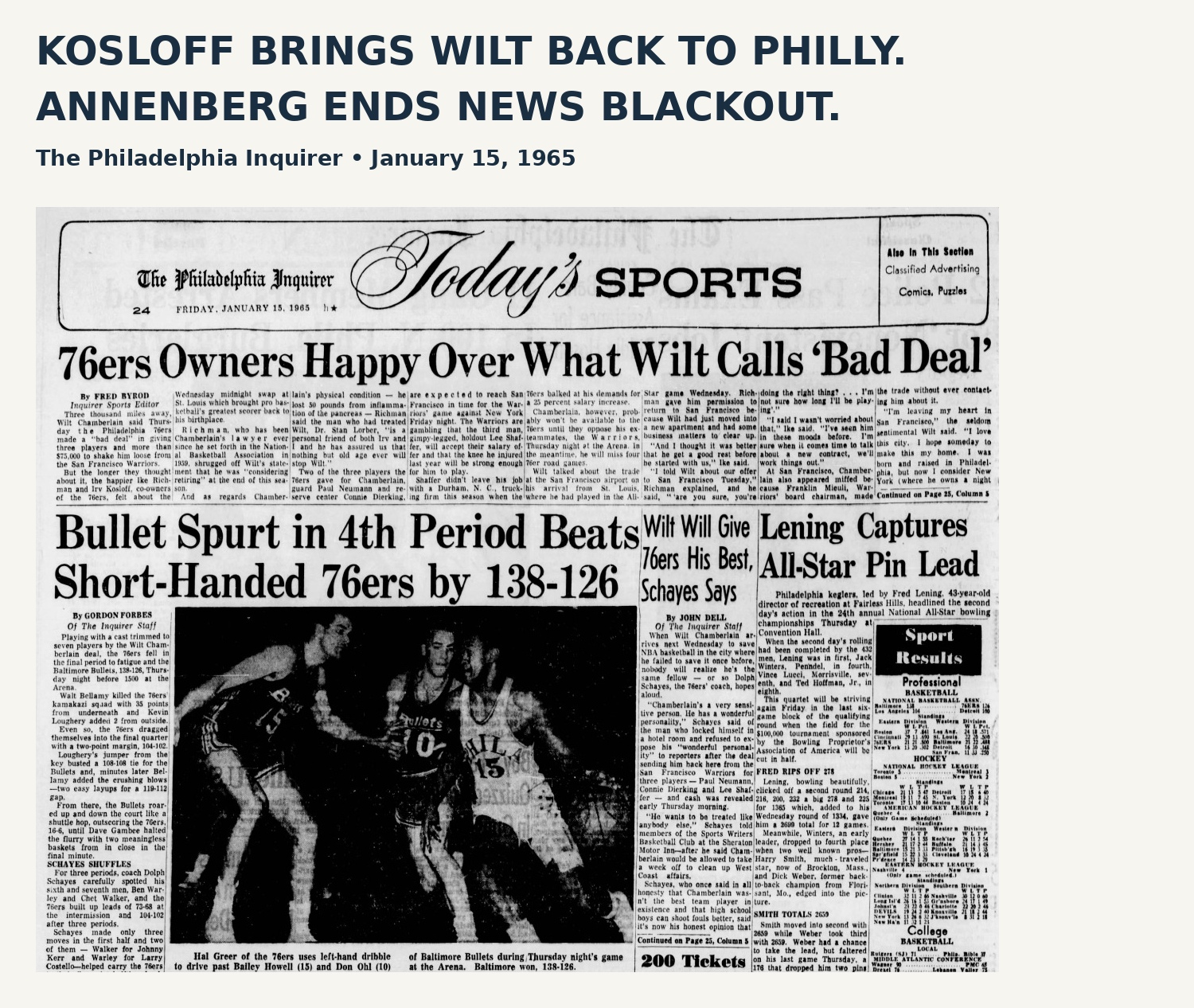
Richman did not live to see what the deal produced. On December 3, 1965, while watching the 76ers play the Celtics at Boston Garden, he suffered a fatal heart attack, leaving Kosloff as sole owner. Chamberlain told the press that Richman had been like a father to him. The Sixers won the NBA championship in 1966–67. Wilt gave the championship game ball to Richman’s widow.
Leave a Reply