A new Dutch ban doesn’t just apply to commercial shipments. It applies to tourists, souvenirs and personal luggage — and can even reach products made elsewhere using materials originating in an Israeli settlement.
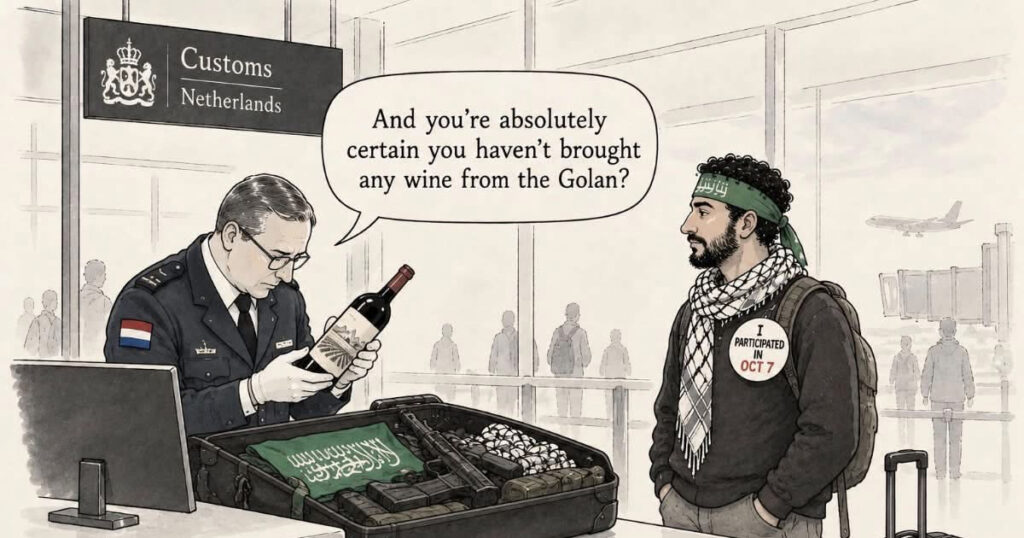
On September 22, the Netherlands put into effect a sweeping new prohibition on goods originating in Israeli settlements in the West Bank — also known to Israelis as Judea and Samaria — East Jerusalem and the Golan Heights.
And this isn’t simply an import regulation aimed at shipping containers and commercial wholesalers.
It applies to ordinary travelers.
Dutch Customs says explicitly that prohibited goods may not be brought into the Netherlands in personal luggage, even when the item is a souvenir, a gift or something intended entirely for personal use. It doesn’t matter if the traveler bought the item before the new rule went into effect.
Read the Dutch Customs guidance for travelers
The practical consequences became apparent almost immediately.
Passengers arriving at Amsterdam’s Schiphol Airport on flights from Tel Aviv reported being stopped and having their luggage inspected. The Times of Israel reported that travelers described the inspections as unusual and intimidating, although subsequent accounts indicated that the searches were less sweeping than some of the earliest reports suggested. Dutch Customs says ethnicity, nationality, religion and appearance are not grounds for selecting a passenger for inspection. The Times of Israel
Israel’s Foreign Ministry subsequently warned travelers that they could encounter lengthy baggage inspections and said it was examining reports concerning how the new Dutch policy was being enforced.
It’s Not Just Where You Bought It
Here’s where the regulation gets considerably more complicated.
The Dutch decree does not merely prohibit a bottle of wine made at a winery in a settlement or dates grown on a settlement farm.
The actual government explanation says the prohibition covers goods that are wholly or partly obtained or produced in a covered Israeli settlement. More significantly, the explanatory memorandum says that goods containing raw materials or semi-finished products originating in a settlement are also within the scope of the decree. Officiële Bekendmakingen
In other words, simply determining where the finished product was made may not answer the question.
Imagine, for example, a Palestinian craftsman in Ramallah makes a decorative doll.
The craftsman is Palestinian. His workshop is in Ramallah, not an Israeli settlement.
But suppose one of the doll’s components or raw materials came from a factory in a nearby Israeli settlement.
Under the language of the Dutch decree, that connection can potentially bring the finished product within the prohibition. The Dutch government’s explanatory memorandum specifically says products containing raw materials or semi-finished goods from a covered settlement fall within the measure. Officiële Bekendmakingen
There is, however, an important wrinkle.
The decree contains an exception for goods qualifying for preferential treatment under applicable European Union trade arrangements. The EU has a separate preferential-trade agreement covering products originating in the West Bank and Gaza Strip, with detailed rules determining when a product manufactured there acquires Palestinian origin.
So our hypothetical Palestinian-made doll is not automatically prohibited merely because some material in it came from an Israeli settlement. Its treatment could depend on the particular materials, how substantially they were transformed, and whether the finished doll qualifies for preferential Palestinian origin under EU rules. Eur-Lex
That is a considerably more complicated question than simply asking, “Where did you buy this?”
Travelers Are Supposed To Know
Dutch Customs puts the burden squarely on travelers.
Its instructions tell passengers to determine where products come from before traveling and to retain labels, packaging or documents establishing origin because Customs may ask for them during an inspection. The Netherlands uses an EU postcode list to identify the Israeli settlements covered by the measure.
If you’re unsure whether an item is prohibited, Customs tells you to use the red “Goods to declare” exit and present it to Customs.
If Customs determines that an item is prohibited, the traveler can surrender it voluntarily. Otherwise Customs can seize it and prepare an official report. Dutch prosecutors then determine whether further action is warranted.
That raises some fairly obvious practical questions.
How is an ordinary tourist supposed to establish where every component of a handmade souvenir originated?
What documentation would a small artisan in Ramallah provide showing where the wood, cloth, paint, metal fasteners or other materials used in a handmade object came from?
And how is a customs officer at Schiphol supposed to determine the answer while inspecting someone’s suitcase?
Those aren’t hypothetical problems created by critics of the policy. The Dutch government itself says importers need evidence concerning whether goods “wholly or partly” originate in the covered settlements, while the instructions for travelers say they should retain documentation demonstrating origin.
The Ban Is Geographical — But Very Specifically Geographical
Another distinction is important.
The Netherlands has not banned goods from the West Bank generally.
Palestinian goods from Ramallah, Bethlehem, Hebron and other Palestinian communities are not prohibited merely because they originate east of the pre-1967 line. The European Commission has long distinguished between products from Palestinian areas of the West Bank and products originating in Israeli settlements. Eur-Lex
Likewise, the Dutch government says the new measure does not alter trade with Israel inside the internationally recognized pre-1967 boundaries. Rijksoverheid
The distinction is specifically between covered Israeli settlements and other places.
That can produce some unusual results.
Two products could be manufactured only a few miles apart in the West Bank. One could be permitted because it qualifies as a Palestinian product, while another could be prohibited because it was made in an Israeli settlement.
And a third product could require considerably more investigation because it was assembled in a Palestinian city using materials obtained elsewhere.
Why The Netherlands Says It Is Doing This
The Dutch government says Israeli settlements in territories occupied since 1967 are unlawful under international law and that the Netherlands has an obligation not to contribute economically to maintaining that situation.
The government says the prohibition is intended to reduce economic support for settlements and cites United Nations resolutions and the International Court of Justice’s July 2024 advisory opinion as part of its legal justification. Rijksoverheid
Israel strongly rejects the Dutch action.
The dispute has already moved beyond airport luggage.
Following implementation of the ban, Israel revoked the diplomatic status of Dutch diplomats working from Ramallah. Reuters reported that Israel explicitly linked the action to the Dutch prohibition on settlement goods.
.
Even a Bottle of Wine Isn’t So Simple
At first glance, wine seems easy.
A bottle produced and bottled at a winery in an Israeli settlement is straightforward. So is a bottle produced inside Israel’s pre-1967 borders.
But suppose the wine was made and bottled by a Palestinian winery in Ramallah using grapes grown in an Israeli settlement in the West Bank.
Now the nationality of the winemaker doesn’t answer the question. Neither does the location of the winery.
The Dutch decree reaches goods containing raw materials or semi-finished products originating in covered Israeli settlements. That means authorities may have to determine where the grapes were grown, and then determine whether the finished Palestinian product nevertheless qualifies for the decree’s exception for goods entitled to preferential treatment under EU rules of origin.
The same problem can arise with other products: a Palestinian craftsman could make a doll in Ramallah using fabric, wood or another component produced in an Israeli settlement.
So the question at Dutch Customs may not simply be:
Where did you buy it?
Or even:
Where was it made?
It can become:
Where did the materials used to make it come from?
And, in some cases:
Did enough processing occur elsewhere to give the finished product a different legal origin under European customs law?
That is a much stronger ending because the wine in your cartoon becomes part of the article’s point: the customs officer asking about “wine from the Golan” sounds simple, but under the actual rules, even determining whether a particular bottle of wine is covered can become surprisingly complicated.
Lorem ipsum dolor sit amet, consectetur adipiscing elit. Ut elit tellus, luctus nec ullamcorper mattis, pulvinar dapibus leo.
Leave a Reply