If Elon Musk had contributed $100 million in mid-October to Tracy Pennycuick and Jarrett Coleman — two Republican state senators who are part of the firewall keeping Democrats from achieving a trifecta in Harrisburg — isn’t that something the public should be able to know before the election?
A contribution like that would be perfectly legal: Pennsylvania sets no limit on what an individual can give a candidate. And it would be disclosed in exactly one place in time to matter — the pre-election campaign finance reports that were due on October 23.
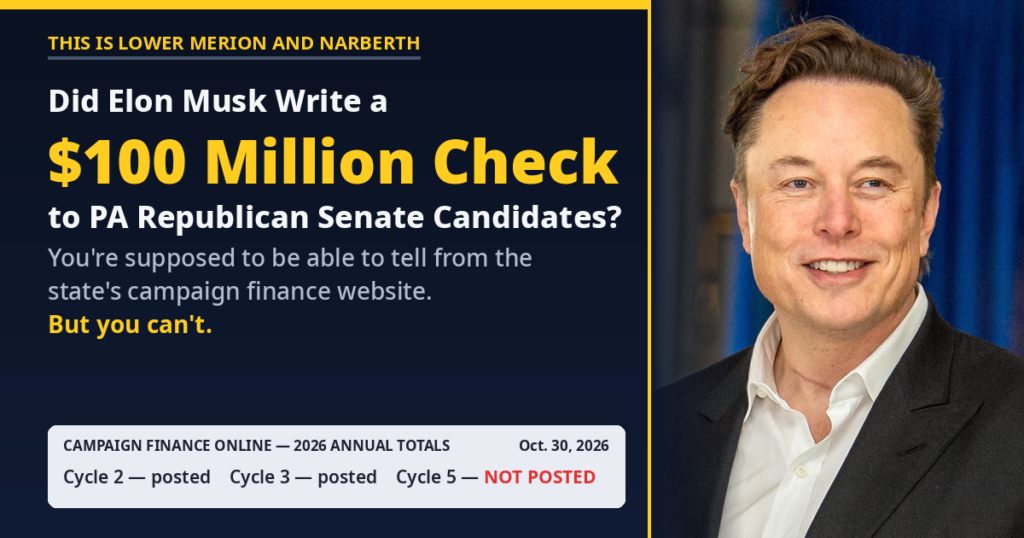
It is now Friday, October 30. There is exactly one business day left before the election. The Pennycuick and Coleman reports still have not been posted on Campaign Finance Online, the Department of State’s public portal. Neither have the reports for their Democratic opponents, Chris Thomas and Eileen Albillar. Neither has the report of the Senate Democratic Campaign Committee.
This is not a partisan grievance — the missing reports belong to both parties, including the campaign arm of the Governor’s own party. It is a competence grievance. The one job the Election Code gives Secretary of the Commonwealth Al Schmidt’s Department of State in the final stretch of a campaign — show the public, before it votes, who is funding the candidates — is the job it has not done.
What Has Posted And What Hasn’t
Some reports made it. Senator Frank Farry’s pre-election report is posted; it shows $4.77 million raised and $4.96 million spent in this period alone. The Senate Republican Campaign Committee’s report is posted. And this morning, the report of Mark Pinsley — the Democratic challenger in District 16 — finally appeared, showing $2.7 million raised.
So the portal works, and the Department is capable of posting reports. It just has not posted these:
- Friends of Chris Thomas (District 24)
- Friends of Tracy Pennycuick (District 24)
- Friends of Eileen Albillar (District 6)
- Patriots for Coleman (District 16)
- Senate Democratic Campaign Committee
The reports were due Friday, October 23. It is now the Friday after — a full week later. Mail ballots have been in Pennsylvania voters’ hands since September. Votes are already being cast, and returned, by people who have no way to see who is funding the candidates on their ballots.
The Committee In The Dark
The Senate Democratic Campaign Committee is the worst of the missing reports, because of where it sits. We know Governor Shapiro’s committee sent it $2,000,000 during the reporting period — we know that only because Shapiro’s report is posted. We know it sent $300,000 to Chris Thomas’s campaign in the past week — we know that only because Thomas’s 24-hour reports show the money arriving. What the public cannot see is the committee’s own report: who else funded it, what it has spent, and where the money went. It is the one dark node in the middle of the money chain. Its Republican counterpart’s report has been public for days.
The 24-Hour Tease
The state’s 24-hour reporting system is working — and it only makes the failure clearer. Since October 20, Thomas’s committee has disclosed $772,794.60 in large contributions, including $343,530 from Governor Shapiro’s committee and $300,000 from the Senate Democratic Campaign Committee. But the 24-hour reports show only money coming in. No spending. No cash on hand. No debts. They were designed as a supplement to the pre-election report, not a substitute for it. What is the point of requiring 24-hour disclosure in the final two weeks of a campaign if the pre-election report those filings supplement is not available to the public?
Asking The Department
On Thursday, I called the Department’s Bureau of Campaign Finance and Lobbying Disclosure. I was told that some of these reports were “available now.” One of them — Pinsley’s — appeared the following morning. The rest did not. The last staffer I spoke with told me to “be patient.”
A voicemail I left for the Bureau’s director was forwarded to the Department’s press office. Its press secretary, Geoff Morrow, wrote back directing that all media inquiries go through the press office, asked me to list the candidates I was asking about, and sent me an Election Code Records Request Form, which he said I would need in order to receive “unredacted copies.”
That is the wrong frame. These are reports the Election Code requires to be disclosed to the public, and Campaign Finance Online is the public’s access to them. No voter — and no reporter — should have to file a records request to see a campaign finance report that was due a week ago.
This morning, I wrote to the press office again — on the record — asking Secretary Schmidt to address three questions: whether the public has been given the disclosure the Election Code intends when pre-election reports in contested races are still unavailable a week after the deadline; whether it is accurate, as Bureau staff told me, that Senator Pennycuick’s report would post Friday and Mr. Thomas’s not until Monday, November 2, the day before the election — and whether the Secretary considers that timely disclosure; and whether these reports were filed on time, and if they were, where the delay has been. I gave the Department until 2 p.m. today to respond. It did not respond.
Misfeasance Or Malfeasance?
Let me be precise about what this is, and what it is not. There is no evidence that anyone at the Department is deliberately suppressing one party’s reports to help the other. The missing reports hurt Republicans and Democrats alike — two Republican incumbents, two Democratic challengers, and the Democrats’ Senate campaign committee. That is not malfeasance.
It is misfeasance: a lawful duty performed so badly that it defeats its own purpose. Disclosure that arrives after the election is not disclosure. It is historical bookkeeping, or archaeology if you prefer.
The Workload Was Not A Surprise And It Is Not An Excuse
None of this snuck up on the Department. The October 23 deadline is set by statute, and it arrives with the same flood of filings in every election cycle. The reports that posted promptly appear to have been filed electronically, which posts them automatically. The Department still permits paper filings for the most time-sensitive report of the cycle — and paper has to be processed by hand, by staff, one report at a time. If the Bureau needed temporary staff to get it done, October was the time to have them in place.
Change the rules and require electronic filing — or be ready for the paper. What the Department cannot do is accept reports on October 23 and still be sitting on them on October 30, while Pennsylvanians are voting.
Leave a Reply